Field guide · Sharks and rays

Malpelo sharks & rays

The nine sharks and the rays you are most likely to meet at Malpelo, with season, depth and site for each, a guide to telling the sharks apart, and summary tables.

Giant oceanic manta
Giant oceanic manta

Background photo: Megan Applegate

Sharks

The shark residents

9 species · flagship first · key marks on each

Scalloped hammerhead (Sphyrna lewini)
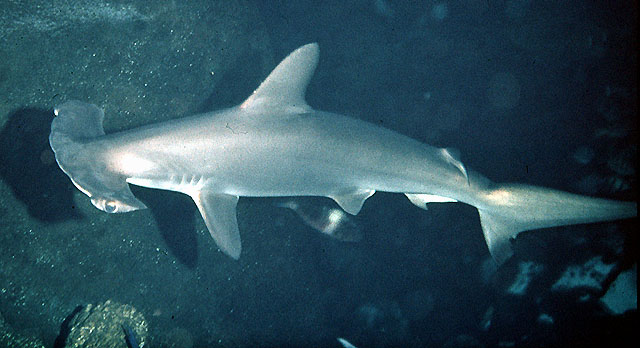
Scalloped hammerhead. Photo from FishBase, where the photographer is credited.

Scalloped hammerhead Sphyrna lewini

The sanctuary's flagship species. Malpelo is described as one of the world's important hammerhead breeding areas. Males mature at roughly 1.5–1.8 m, females near 2.5 m, and the species can reach about 4.3 m. The IUCN lists it as Critically Endangered, mainly from overfishing for fins.

Key marks: The head is flattened into a hammer with a scalloped front edge: a notch in the middle and a shallow scallop either side of it. Eyes at the very tips. Tall, strongly curved first dorsal fin and a small second dorsal. Bronze-grey above, pale below. In open water you usually get the silhouette from below before any colour, so go by the shape of the head.

At Malpelo: Present year-round and densest December to April. Reliability is very high, at 18–35 m. Schools of 200–500 have been reported at El Bajo del Monstruo. La Nevera is considered the best site, because of its cleaning stations. DAN reports four passes of 20 to 50 animals there at about 24 m, and hammerheads at El Bajón at about 30 m. Shallow cleaning-station visits are more likely in winter. In June, one diver saw schools of up to about 12, far off in the blue water and moving deeper as the water warmed (Interceptor121).

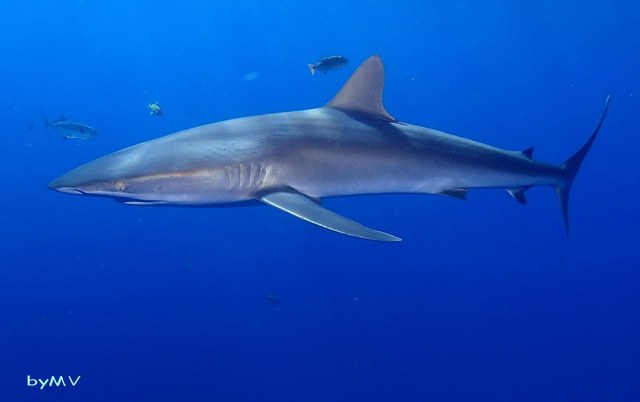
Silky shark (Carcharhinus falciformis)
Silky shark.

Silky shark Carcharhinus falciformis

One of the most abundant pelagic sharks worldwide, and the one you see in the greatest numbers at Malpelo. Named for its fine, smooth skin. Slender body, small first dorsal fin, long sickle-shaped pectoral fins. Typically about 2.5 m, and often trails tuna schools. Listed as Vulnerable.

Key marks: A very small second dorsal fin with a long, thin trailing tip is the best single mark. The first dorsal is low and rounded and starts behind the pectoral fins. Long, narrow, sickle-shaped pectorals, dusky on the underside of the tips. Slim and smooth, bronze above and white below, usually out in the blue and in numbers.

At Malpelo: Present year-round and strongest April to July. Reliability is very high, at 5–35 m. Often circles divers during safety stops. Also seen at El Bajo del Monstruo and El Bajo de Virginia. DAN reports that large groups once gathered at El Acuario in late spring and summer, but says numbers have fallen over the past 10 to 15 years. The Interceptor121 author saw few silkies where tiger sharks were present and suggests the tigers prey on them.

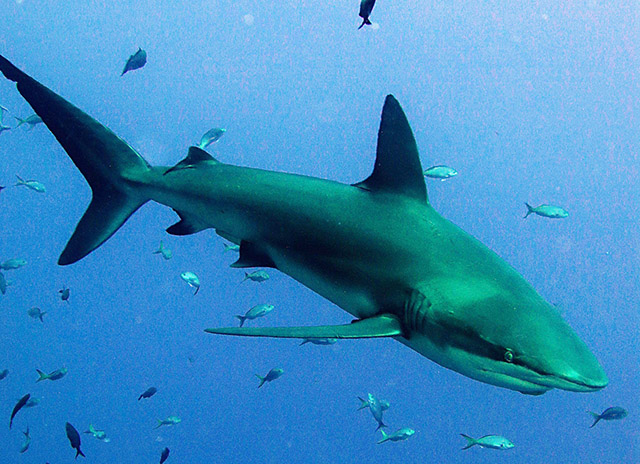
Galápagos shark (Carcharhinus galapagensis)
Galápagos shark. Photo from FishBase, where the photographer is credited.

Galápagos shark Carcharhinus galapagensis

A reef shark of clear water around oceanic islands, often the most abundant shark in shallow island waters. Commonly about 3 m, with a tall first dorsal fin. Easily confused with the silky shark. See Telling the sharks apart. Listed as Least Concern, but it reproduces slowly.

Key marks: Stocky and plain grey-bronze, with a broad, rounded snout and a heavy look to the head and shoulders. The first dorsal is tall and upright and starts roughly above the pectoral tips. A low ridge of skin runs along the back between the two dorsal fins. No strong dark or white fin markings. Works the reef and the walls, and will come in close.

At Malpelo: Present year-round. Reliability is high, at 20–40 m. Noted at El Freezer, El Bajo del Monstruo and El Bajo de Virginia. Some are very large and come close. DAN reports eight or more at the David seamount, and one cutting through a fish school at El Arrecife.

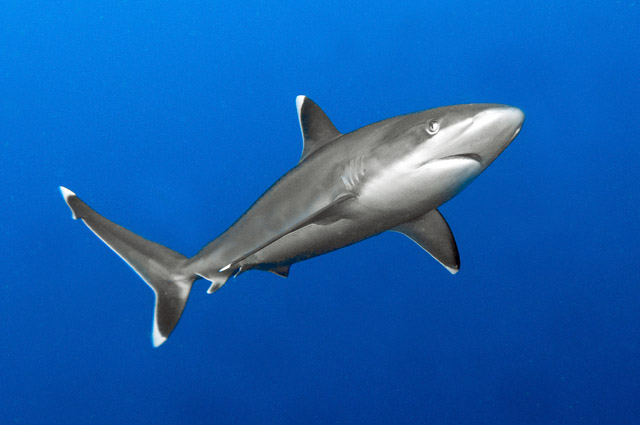
Silvertip shark (Carcharhinus albimarginatus)
Silvertip shark. Photo from FishBase, where the photographer is credited.

Silvertip shark Carcharhinus albimarginatus

A large grey shark with bright white edges on the tips of its fins, which makes it easy to pick out from the grey sharks around it.

Key marks: White edging on almost every fin: the tip of the first dorsal, the tips and trailing edges of the pectorals, and the tail. Larger and bulkier than the whitetip reef shark, with a longer snout, and it keeps cruising off the reef instead of resting on the bottom.

At Malpelo: Present year-round but only occasionally seen, at 20–40 m. DivePass names no particular site.

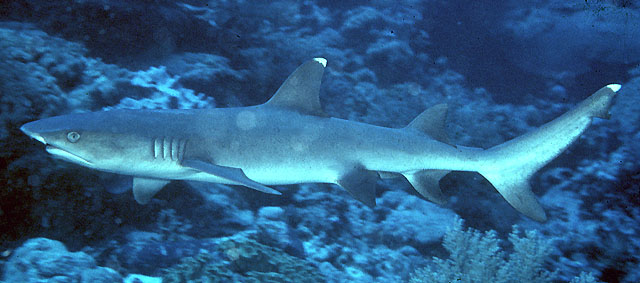
Whitetip reef shark (Triaenodon obesus)
Whitetip reef shark. Photo from FishBase, where the photographer is credited.

Whitetip reef shark Triaenodon obesus

A slim, fairly small reef shark with white tips on the first dorsal fin and the upper tail lobe. It spends much of the day resting on the bottom, in caves and under ledges.

Key marks: Small and slim, with a short, blunt snout. A white tip on the first dorsal and on the upper lobe of the tail, often on the lower lobe too. The pectoral fins are plain. Usually lying still on sand or under a ledge during the day. Do not confuse it with the silvertip, which is much bigger, has white edging on all its fins, and does not rest.

At Malpelo: Present year-round, and very reliable at most sites, at 5–35 m. Look for it resting in the sandy alleys at La Catedral and in the gullies at Los Mosqueteros. Interceptor121 calls it quite common, and DAN saw one inside a cavern near blue-and-gold snappers. Of eight REEF surveys made at Malpelo on 10–12 October 2026, the 10 October morning dive lists one white-tipped reef shark. Scalloped hammerheads are on two: a single one on the 10 October afternoon dive and a few (2–10) on the 11 October afternoon dive. The only other shark on the sheets is a single Galápagos shark on the 11 October late-morning dive.

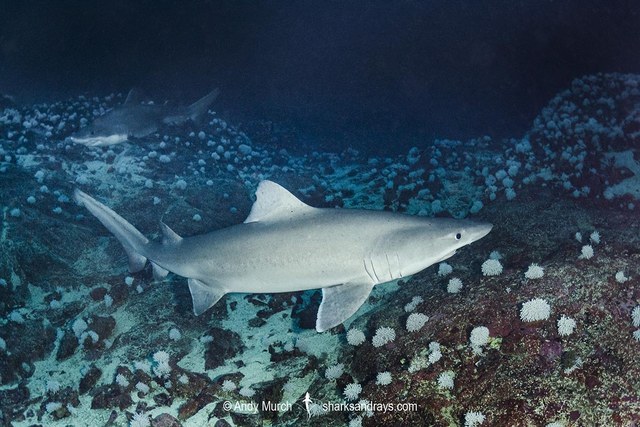
Smalltooth sand tiger (Odontaspis ferox)
Smalltooth sand tiger. Photo © Andy Murch, sharksandrays.com.

Smalltooth sand tiger Odontaspis ferox

A deep-water shark that Malpelo is one of the few places to have confirmed. It is bulky, with long teeth that show even when the mouth is closed, and its two dorsal fins are almost the same size. See Telling the sharks apart.

Key marks: The second dorsal fin is almost as big as the first, which none of the other sharks here show. Long, narrow teeth stick out even with the mouth shut. Large eye, short pointed snout, and a bulky brownish body that sometimes carries dark spots.

At Malpelo: Present year-round, with moderate reliability, at 25–40 m. Look on the deeper faces of El Bajo del Monstruo, and by day at La Gringa. DAN says it is usually deep at El Monstruo but sometimes as shallow as about 21 m in winter, and its author saw none in July.

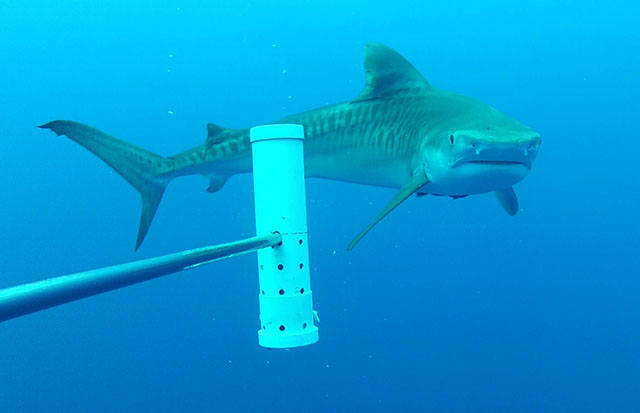
Tiger shark (Galeocerdo cuvier)
Tiger shark. Photo from FishBase, where the photographer is credited.

Tiger shark Galeocerdo cuvier

A large shark with a blunt, square snout. Young animals have dark vertical stripes that fade with age.

Key marks: A very blunt, square snout on a broad head. Dark vertical bars and blotches down the flanks, strong on young animals and faded on big adults. Heavy-bodied, with a long upper tail lobe.

At Malpelo: Present year-round but only occasionally seen, at 15–30 m. DivePass names no particular site. Interceptor121 reports tiger sharks as present.

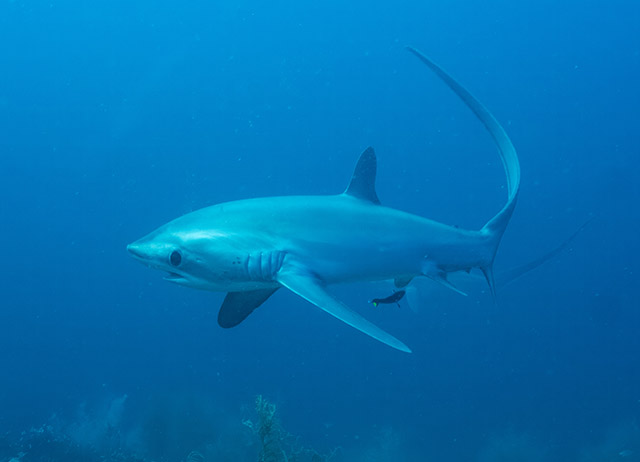
Pelagic thresher (Alopias pelagicus)
Pelagic thresher. Photo from FishBase, where the photographer is credited.

Pelagic thresher Alopias pelagicus

A slender shark whose upper tail lobe is as long as the rest of its body, which is unmistakable when you see it.

Key marks: The upper lobe of the tail is as long as the rest of the shark, and nothing else here comes close. Slender body, small mouth, large eye, and long dark pectoral fins.

At Malpelo: Present year-round, but a rare sighting, at 20–40 m. DivePass names no particular site.

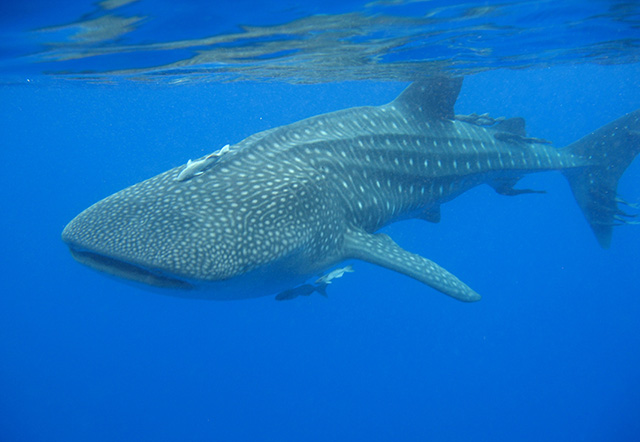
Whale shark (Rhincodon typus)
Whale shark. Photo from FishBase, where the photographer is credited.

Whale shark Rhincodon typus

Recorded at Malpelo but a rare sighting. The largest fish in the world, a filter feeder that is harmless to divers. Listed as Endangered. Each animal has a unique spot pattern, which researchers use to identify individuals.

Key marks: Unmistakable. Very large, with a broad flat head and a wide mouth right at the front of the snout rather than slung underneath. Dark grey-blue with a chequerboard of pale spots and bars, and three ridges running the length of each flank. The spot pattern is unique to each animal, which is how researchers tell them apart.

At Malpelo: Seen June to October, occasionally, at 5–30 m. It passes through, and has been noted at El Bajo de Virginia, El Freezer and El Bajón. DAN describes a 30-minute snorkel with one at El Bajo del Ancla, where it was feeding on spawn from bigeye jacks. Interceptor121 reports another that came up under the dive boat after a dive at El Bajo del Monstruo.

Checkpoint — you can now tell the main sharks apart by head shape and fin form, and you know the season and depth to look for each.

Identification

Telling the sharks apart

Add-on page

Hammerheads and whale sharks are easy to recognise. For the other seven sharks, the add-on page has a labelled anatomy diagram, a short key, a profile of each shark, a side-by-side table, the pairs that get confused, and depth and season ranges.

Open Telling the sharks apart →

Rays

Mantas and eagle rays

Seasonal · mostly in the blue

Season, depth and site details on this page come from the DivePass Malpelo guide. Photos are from FishBase, where the photographers are credited.

Giant oceanic manta (Mobula birostris)
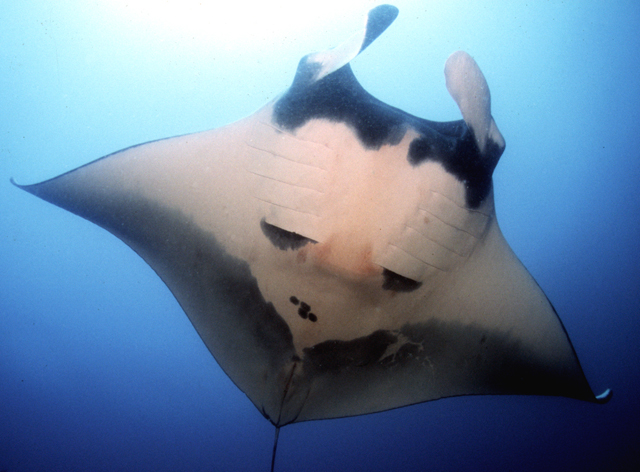
Giant oceanic manta. Photo from FishBase, where the photographer is credited.

Giant oceanic manta Mobula birostris

The largest ray, with a wingspan up to about 7 m. It comes to cleaning stations to have parasites removed.

At Malpelo: Seen May to October, with moderate to high reliability. Seen periodically at El Bajo de Virginia. DAN mentions mantas only as migratory visitors to the island.

Pacific eagle ray (Aetobatus laticeps)
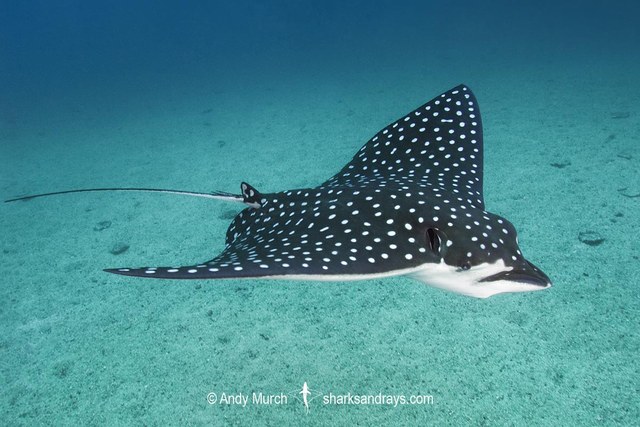
Pacific eagle ray. Photo from sharksandrays.com.

Pacific eagle ray Aetobatus laticeps

A spotted eagle ray that flies along in a steady glide, with a pointed head and a long tail.

At Malpelo: Present year-round, with moderate reliability. Look for small groups over the pinnacles and boulder slopes. Eagle rays (species not specified) also patrol the peaks at Los Gemelos. DAN saw a spotted eagle ray, probably the same animal under an older name, eating a thorny oyster in shallow water, and Interceptor121 reports up to six together that were easy to follow. The October 2026 REEF survey sheets list a spotted eagle ray under the name Aetobatus narinari: one on 10 October 2026 (Single) and a few on 11 October (Few, 2–10).

Devil rays Mobula spp.

Smaller relatives of the manta that are hard to tell apart at a glance.

At Malpelo: Present year-round but only occasionally seen, usually out in the blue water.

Listed elsewhere, not at Malpelo

The DivePass guide says the marbled ray (Taeniurops meyeni), which is sometimes listed for Malpelo, does not belong there.

Possibles

Possible but unconfirmed

1 shark · 1 ray

These two are included as possible sightings. This primer has no Malpelo sighting notes for them and has not confirmed that either has been recorded at Malpelo, so treat them as possibles and check with the dive guides.

Table — Possible shark and ray, sorted by family, with the marks to look for.
PhotoCommon nameSpeciesFamilyKey marksProfile
No photo yetBlacktip sharkCarcharhinus limbatusCarcharhinidae · requiem sharksBlack tips on the first dorsal, the pectorals and the lower lobe of the tail, on a slim body with a long pointed snout. The anal fin tip stays pale, which is what separates it from the blacktip reef shark.FishBase · Smithsonian
No photo yetPacific cownose rayRhinoptera steindachneriRhinopteridae · cownose raysA blunt, notched snout like a cow’s nose, plain golden-brown above with no spots, and pointed wings. Swims up in the water column, often in groups, rather than lying on the bottom.FishBase · Smithsonian

Quick ref

Sharks and rays at a glance

Keep at hand

Table 1 — Malpelo shark summary. Season, depth and reliability are from the DivePass guide. Size and status are from the linked pages, and the figures for the five newest rows still need checking.
PhotoSpeciesTypical sizeIUCN statusSeasonDepthReliability and note
Scalloped hammerhead (Sphyrna lewini)Scalloped hammerheadup to ~4.3 mCritically EndangeredYear-round, densest Dec–Apr18–35 mVery high · schools of 200–500
Silky shark (Carcharhinus falciformis)Silky shark~2.5 mVulnerableYear-round, strongest Apr–Jul5–35 mVery high · circles divers on safety stops
Galápagos shark (Carcharhinus galapagensis)Galápagos shark~3 mLeast ConcernYear-round20–40 mHigh · reef-associated resident
Silvertip shark (Carcharhinus albimarginatus)Silvertip shark~2.5–3 mVulnerableYear-round20–40 mOccasional
Whitetip reef shark (Triaenodon obesus)Whitetip reef shark~1.6 mVulnerableYear-round5–35 mVery high at most sites · rests in sandy alleys
Smalltooth sand tiger (Odontaspis ferox)Smalltooth sand tigerup to ~4.5 mVulnerableYear-round25–40 mModerate · deeper faces, La Gringa by day
Tiger shark (Galeocerdo cuvier)Tiger sharkup to ~5 mNear ThreatenedYear-round15–30 mOccasional
Pelagic thresher (Alopias pelagicus)Pelagic thresherup to ~3.3 mEndangeredYear-round20–40 mRare
Whale shark (Rhincodon typus)Whale shark8–14 m+EndangeredJun–Oct5–30 mOccasional · passes through
Table 2 — How the Malpelo sharks reproduce, and what else sets them apart. Figures are from each species' Wikipedia page, linked in the profiles above, and vary by region and study. The hammerhead's placental mode and birth size are from general references.
SpeciesHow the young developLitterPregnancySize at birthBreedsAlso different
Scalloped hammerheadPlacental live birth12–41About 12 monthsAbout 0.4–0.5 mProbably every yearFemales return to the nursery area where they were born, and the young spend their first years in coastal shallows and mangroves. Navigates using the Earth's magnetic field.
Silky sharkPlacental live birth1–16, usually 6–1212 monthsAbout 0.7 m in the eastern PacificYear-round in most regionsVery sensitive to low-frequency sound, which draws it in from hundreds of metres. Pups start on outer-shelf reefs, then move to open ocean within months. Matures at 6–12 years.
Galápagos sharkPlacental live birth4–16About a year0.6–0.8 mEvery 2–3 yearsYoung stay in shallow nurseries to avoid being eaten by adults. Gives an arched-back, fins-down threat display when cornered.
Silvertip sharkPlacental live birth1–11, usually 5–6About a year0.6–0.8 mEvery 2 yearsDominates Galápagos sharks of the same size at food. Adults are often heavily scarred from fights with each other.
Whitetip reef sharkPlacental live birth1–6, usually 2–310–13 months0.5–0.6 mEvery 2 yearsCan pump water over its gills, so it can rest still on the bottom. Slow to mature, at 8–9 years.
Smalltooth sand tigerPresumed live birth with egg-eating embryos. No pregnant female has ever been found.UnknownUnknownEstimated 1.0–1.1 mUnknownA very large, oily liver keeps it neutrally buoyant. The same individuals return to known sites year after year.
Tiger sharkLive birth with no placenta. Eggs hatch inside, and embryos are fed by a uterine fluid.10–80Up to 16 months0.5–0.8 mEvery 3 yearsThe largest litters of the sharks here, apart from the whale shark, and the widest diet of any shark.
Pelagic thresherLive birth with no placenta. Embryos eat eggs the mother keeps producing.2, one in each uterusUncertain, perhaps under a yearUp to 1.6 m, about 43% of the mother's lengthNo season. Most adult females are pregnant year-round.The fewest and largest pups. Stuns schooling fish with whip strikes of its tail.
Whale sharkLive birth with no placenta. Eggs hatch inside the mother.About 300 in one pregnant female that was examinedUnknown0.4–0.6 mUnknown. Females appear to store sperm and produce pups over a long period.The most pups and, for its size, the smallest. Males mature at about 25 years, and lifespan is estimated at 80–130 years.

Reproduction terms

All nine sharks give birth to live young (they are viviparous). None lays eggs. They differ in how the embryo is fed.

  • Placental viviparity: the embryo first lives on its yolk. The empty yolk sac then attaches to the wall of the uterus and works like a placenta, so the mother feeds the embryo directly.
  • Aplacental viviparity (ovoviviparity): the eggs hatch inside the mother and there is no placenta. The embryo lives on its yolk, and in some species on a fluid the uterus produces.
  • Oophagy: a form of aplacental viviparity in which the embryos eat unfertilised eggs that the mother keeps producing. Litters are very small and the pups are born very large.
Table 3 — Malpelo rays, from the DivePass guide.
PhotoSpeciesSizeSeasonReliability and note
Giant oceanic manta (Mobula birostris)Giant oceanic mantawingspan up to ~7 mMay–OctModerate to high · cleaning stations, El Bajo de Virginia
Pacific eagle ray (Aetobatus laticeps)Pacific eagle ray—Year-roundModerate · small groups over pinnacles
No photo yetDevil rays (Mobula spp.)—Year-roundOccasional · blue water
← Overview