Birds

San Carlos birds

Thousands of nesting brown boobies and pelicans on San Pedro Nolasco, the Gulf’s own yellow-footed gull, and the herons and spoonbills of Estero El Soldado.

Background photo: Megan Applegate (Malpelo, Colombia)

Island colonies

Seabirds of San Pedro Nolasco

Seen on the boat ride to the sea lions

Brown pelican Pelecanus occidentalis

Key marks: A large, grey-brown pelican with a long bill and throat pouch that dives head first from the air to catch fish (Wikipedia).

At San Carlos: About 3,000 brown pelicans nest on San Pedro Nolasco (Key Biodiversity Areas). In the 1930s the island was the main pelican nesting colony on the Sonora coast, with several thousand pairs (van Rossem 1945).

Coast

Gulls, frigatebirds and ospreys

Along the shore between dives

Heermann’s gull Larus heermanni

Key marks: Grey body, a darker back and a red bill with a black tip (Wikipedia).

At San Carlos: About 90% of the world’s roughly 150,000 pairs nest on Isla Rasa, in the Midriff Islands north of San Carlos (Wikipedia).

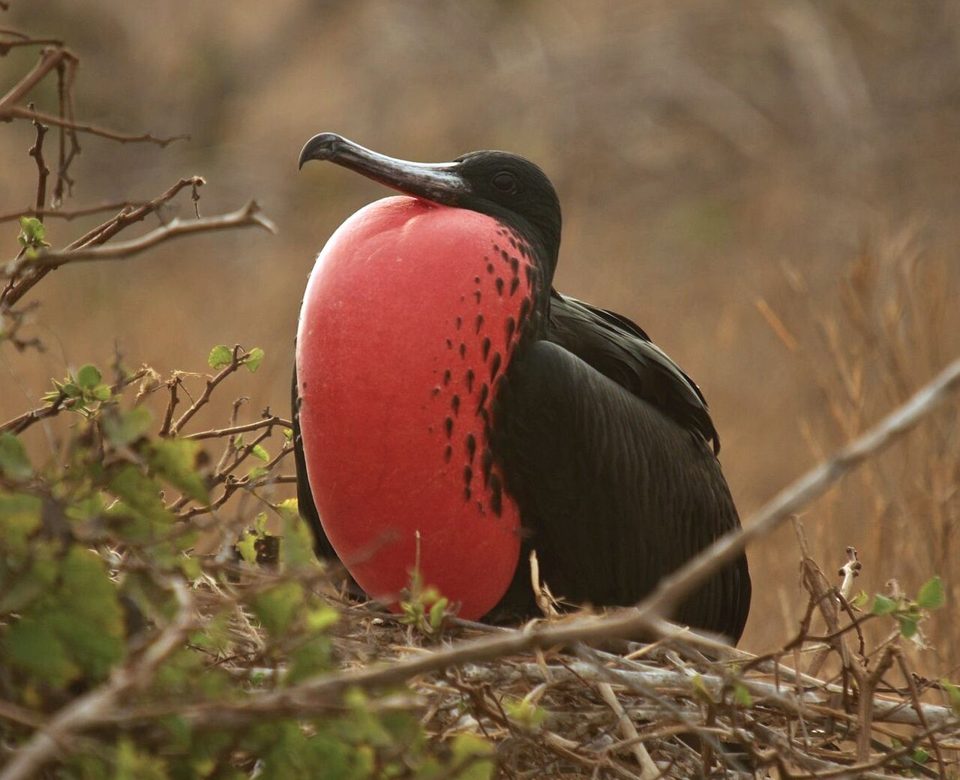
Magnificent frigatebird (Fregata magnificens)
Magnificent frigatebird. Reference photo, not taken at San Carlos; see the credits below.

Magnificent frigatebird Fregata magnificens

Key marks: Long, narrow, angled wings and a deeply forked tail; males black with a red throat pouch, females with a white breast (Wikipedia).

At San Carlos: Recorded at San Pedro Nolasco and Guaymas, but no frigatebird colony was known in Sonora in the 1940s (van Rossem 1945).

Possible but unconfirmed

Red-billed tropicbirds bred on San Pedro Mártir and George islands in the 1940s (van Rossem 1945); no record of them nesting on San Pedro Nolasco was found.

Wetland

Estero El Soldado

A mangrove estuary at the edge of town

Estero El Soldado, about 20 km from Guaymas, has been a state protected natural area since 2006 and is a Ramsar wetland of 349.89 ha with three species of mangrove (Mongabay Latam; Ramsar). Sources give different bird counts: more than 200 species (Sonoran Joint Venture), or 75 of the 408 species recorded there (Mongabay Latam).

Birds seen there on a World Wetlands Day visit included the roseate spoonbill, osprey, white-faced ibis, long-billed curlew, reddish egret, little blue heron and American oystercatcher (Sonoran Joint Venture).

Land

The island’s own iguana

Found nowhere but San Pedro Nolasco

San Pedro Nolasco spiny-tailed iguana Ctenosaura nolascensis

Vulnerable on the IUCN Red List (Wikipedia).

Key marks: A spiny-tailed iguana found only on San Pedro Nolasco (Wikipedia); it eats mainly cactus fruit and stems (Wikipedia).

Also: The island also has its own cactus, Echinocereus websterianus, and had its own deer mouse, now extinct (Wikipedia). The island is protected as a nature reserve (Wikipedia); watch from the boat.

Credits

Bird photo credits

Reference photos and their sources

There are no photos from San Carlos on this page yet. The frigatebird is a reference photo taken elsewhere, credited below; the other animals link to photos online.

Photo credits. Each link opens the page the photo came from.
SpeciesPhotographerLicenceSource
Magnificent frigatebirdAndrew Turner from Washington, DC, United StatesCC BY 2.0Wikimedia Commons