Field guide · Identification add-on

Telling the sharks apart

How to identify the sharks you are likely to see at Malpelo from a few seconds of looking: what to check, in what order, and which pairs get confused. It covers seven sharks. Hammerheads and whale sharks are easy to recognise, so they are left out.

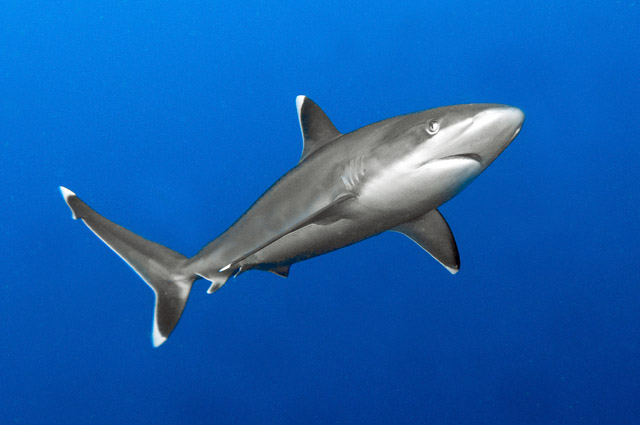
Silvertip shark
Silvertip shark

Background photo: Megan Applegate

Approach

How to look

~2 min · read first

Most shark sightings at Malpelo are brief. The animal is far off, against blue water, or already turning away. You will rarely get a clear look at colour, because light and depth change it. Fin shape and body shape hold up much better, so build the habit of checking the same things in the same order.

  1. Size and build. Is it slim or stocky, small or very large?
  2. Head and snout. Long and rounded, short and blunt, or square?
  3. First dorsal fin. Tall or low, upright or swept back, and where it starts compared with the pectoral fins.
  4. Second dorsal fin. Tiny, ordinary, or almost as big as the first. This one fin settles several questions.
  5. Pectoral fins and tail. Dark tips, white edges, and the length of the upper tail lobe.
  6. Only then, colour and behaviour. Is it resting, patrolling a wall, or circling in open water?

Let depth and season do some of the work

Not every shark is possible at every depth or time of year. A shark at 5 m in July is most likely a silky, a whitetip or a whale shark. A shark deeper than 35 m is more likely a Galápagos, silvertip, sand tiger or thresher. The table near the end of this page lists the ranges.

Anatomy

The parts to know

One diagram · ten parts

Generic shark, side view, with ten parts numbered A shark facing left. Numbers mark the head and snout, first dorsal fin, interdorsal ridge, second dorsal fin, pectoral fin, pelvic fin, anal fin, upper tail lobe, lower tail lobe and gill slits. 1 2 3 4 5 6 7 8 9 10
A generic shark seen from the side, for naming the parts. It is not any one species.
Parts of the shark and what to check on each
No.PartWhat to check
1Head and snoutLong and rounded, short and pointed, or blunt and square. Teeth showing with the mouth closed.
2First dorsal finHeight, how far it leans back, tip shape, and white edges. Also where its front edge starts compared with the pectoral fins.
3Interdorsal ridgeA low ridge of skin along the back between the two dorsal fins. Present in some sharks and not obvious in others.
4Second dorsal finTiny, ordinary, or almost as big as the first. Look for a long thin trailing tip.
5Pectoral finsLong and narrow or broad. Dark tips on the underside, or white edges.
6Pelvic finsSmall paired fins under the rear of the body. Useful mainly for judging where the first dorsal sits.
7Anal finA single small fin under the tail end. Not needed for these species.
8Upper tail lobeShort and ordinary, or very long. A white tip.
9Lower tail lobeUsually much shorter than the upper lobe. Check for a white tip.
10Gill slitsFive slits on each side for these sharks. They help you tell the head end from the body.

Quick key

Five questions

Work down the list

  1. Is the upper lobe of the tail as long as the whole body? It is a pelagic thresher. Nothing else has a tail like it.
  2. Is it a stout shark with two dorsal fins of nearly the same size, and teeth that stick out of a closed mouth? It is a smalltooth sand tiger.
  3. Is it a big, heavy shark with a blunt, square snout and faint dark bars on the flanks? It is a tiger shark.
  4. Do the fins have clean white tips or edges? A slim, smallish shark with white only on the dorsal fins and tail tips, often resting on the bottom, is a whitetip reef shark. A larger shark with white edges on nearly every fin, including the pectorals, is a silvertip.
  5. Otherwise it is grey, with no white or dark markings on the fins. Look at the second dorsal fin. A tiny second dorsal with a long thin trailing tip points to a silky shark. A small, ordinary second dorsal and a tall, upright first dorsal point to a Galápagos shark.
Checkpoint — if you can answer these five questions about a shark in a photo, you can name every shark on this page.

Profiles

The seven sharks

What to look for · what it gets confused with

Silky shark (Carcharhinus falciformis)
Silky shark.

Silky shark Carcharhinus falciformis

  • Look for: a slim, tapering body, a small head with a long rounded snout, and a low rounded first dorsal that starts behind the tips of the pectoral fins. The second dorsal is tiny, with a very long thin trailing tip, which is the best single mark. The pectoral fins are long and narrow and have dark tips underneath. Bronze-grey above, white below.
  • Easily mistaken for: the Galápagos shark.
  • At Malpelo: the shark you see in the greatest numbers, often in groups in open water. It is strongest April to July at 5–35 m, and often circles divers during safety stops. DAN reports that large groups at El Acuario have declined over the past 10 to 15 years.
Galápagos shark (Carcharhinus galapagensis)
Galápagos shark. Photo from FishBase, where the photographer is credited.

Galápagos shark Carcharhinus galapagensis

  • Look for: a stocky body, a broad rounded snout, and a tall upright first dorsal that starts roughly over the tips of the pectoral fins. The second dorsal is an ordinary small fin with a short tip, and there is a low ridge on the back between the dorsals. The pectoral fins are broad and have no strong dark tips. Plain grey-bronze.
  • Easily mistaken for: the silky shark.
  • At Malpelo: a reef-associated resident at 20–40 m, found year-round, usually near the walls and reef, and often bold around divers. Some are very large and come close. DAN reports eight or more at David and one at El Arrecife.
Silvertip shark (Carcharhinus albimarginatus)
Silvertip shark. Photo from FishBase, where the photographer is credited.

Silvertip shark Carcharhinus albimarginatus

  • Look for: a larger, bulkier grey shark with a clean white edge on the tips and rear edges of nearly every fin, the pectoral fins included. The first dorsal is tall and curved. It swims actively and does not rest on the bottom.
  • Easily mistaken for: the whitetip reef shark. Check whether the pectoral fins have white.
  • At Malpelo: present year-round but only occasionally seen, at 20–40 m. DivePass names no particular site.
Whitetip reef shark (Triaenodon obesus)
Whitetip reef shark. Photo from FishBase, where the photographer is credited.

Whitetip reef shark Triaenodon obesus

  • Look for: a slim, smallish body and a short, blunt snout. The first and second dorsal fins both have white tips, and so does the upper tail lobe, often the lower lobe as well. The pectoral fins are plain, with no white.
  • Easily mistaken for: the silvertip, because both show white on the fins.
  • At Malpelo: very reliable year-round at most sites, at 5–35 m. Look for it resting on the bottom in the sandy alleys at La Catedral and in the gullies at Los Mosqueteros. Divers also report it as quite common, and one was seen inside a cavern.
Smalltooth sand tiger (Odontaspis ferox)
Smalltooth sand tiger. Photo © Andy Murch, sharksandrays.com.

Smalltooth sand tiger Odontaspis ferox

  • Look for: a bulky brownish body, sometimes with dark spots, a short pointed snout and a large eye. The long narrow teeth stick out even when the mouth is closed. The first dorsal is medium-sized and sits far back, closer to the pelvic fins than to the pectorals, and the second dorsal is almost as big as the first. That second fin is the key mark.
  • Easily mistaken for: any large grey shark, until you see the two matching dorsals and the teeth.
  • At Malpelo: present year-round with moderate reliability, at 25–40 m. Look on the deeper faces of El Bajo del Monstruo, and by day at La Gringa. DAN says it is usually deep but sometimes as shallow as about 21 m in winter.
Tiger shark (Galeocerdo cuvier)
Tiger shark. Photo from FishBase, where the photographer is credited.

Tiger shark Galeocerdo cuvier

  • Look for: a large, heavy body with a very blunt, square snout and a broad head. Dark vertical bars or spots show on the flanks, and they fade on big adults. The upper tail lobe is long. The pectoral fins are long and broad.
  • Easily mistaken for: little else at Malpelo. Size and the square snout settle it.
  • At Malpelo: present year-round but only occasionally seen, at 15–30 m. DivePass names no particular site. One diver reports tiger sharks as present and suspects they keep silky sharks away from some sites.
Pelagic thresher (Alopias pelagicus)
Pelagic thresher. Photo from FishBase, where the photographer is credited.

Pelagic thresher Alopias pelagicus

  • Look for: a slender body with a short pointed snout, a small mouth and a large eye. The upper lobe of the tail is as long as the body, and the pectoral fins are long and dark. That tail is the one thing to look for.
  • Easily mistaken for: nothing at Malpelo. The tail settles it.
  • At Malpelo: present year-round but rare, at 20–40 m. DivePass names no particular site.
Field marks side by side. Compare the columns from left to right.
PhotoSharkHead and snoutFirst dorsal finSecond dorsal finPectoral finsBody, colour and habit
Silky shark (Carcharhinus falciformis)Silky sharkSmall head with a long, rounded snout. Looks slim and tapered.Low and rounded, set well back, starting behind the pectoral fins.Very small, with a very long thin trailing tip. This is the best single mark.Long and narrow, curved like a sickle. The undersides of the tips are dark.Slender and smooth, bronze-grey above, white below. Often in open water, in big groups.
Galápagos shark (Carcharhinus galapagensis)Galápagos sharkBroad, rounded snout. Looks heavier in the head and shoulders.Tall, upright and moderately curved, starting roughly above the pectoral fin tips.Smaller than the first dorsal but not tiny, with a short trailing tip.Broad, with no strong dark tips.Stocky, plain grey-bronze. A low ridge runs along the back between the dorsal fins. Hugs the reef and walls, and can approach divers closely.
Silvertip shark (Carcharhinus albimarginatus)Silvertip sharkLongish, rounded snout. Larger and bulkier than the whitetip.Tall and curved, with a clean white edge.Smaller, with a white edge.White edges on the tips and rear edges.Grey above, with white edging on almost every fin. Cruises off the reef in the open water rather than resting.
Whitetip reef shark (Triaenodon obesus)Whitetip reef sharkShort, blunt snout on a slim body. Small.Rounded. White tip.Rounded. White tip.Plain, with no white.The tail has a white tip on the upper lobe, and often on the lower lobe too. Rests on the bottom, in sandy alleys and under ledges, by day.
Smalltooth sand tiger (Odontaspis ferox)Smalltooth sand tigerShort, pointed snout. Large eye. Long, narrow teeth are visible even with the mouth closed.Medium, set far back, closer to the pelvic fins than to the pectorals.Almost as big as the first dorsal. This is the key mark.Fairly small.Bulky, brownish, sometimes with dark spots. Lives in deep water and rarely seen.
Tiger shark (Galeocerdo cuvier)Tiger sharkVery blunt, square snout. Broad head.Fairly tall and slightly curved.Small.Long and broad.Large and heavy. Dark vertical bars or spots on the flanks, faint on big adults. The upper tail lobe is long.
Pelagic thresher (Alopias pelagicus)Pelagic thresherShort, pointed snout. Small mouth and large eye.Medium, set far forward.Very small.Long and dark.Slender. The upper lobe of the tail is as long as the body. This is the one thing to look for.

Lookalikes

Pairs that get confused

Three pairs

Silky or Galápagos?

Both are grey, torpedo-shaped sharks of similar size, and divers often mix them up. Ignore the colour and look at the fins.

Silky: slim, a low and rounded first dorsal, a tiny second dorsal with a long trailing tip, and long narrow pectoral fins with dark tips below. Usually in open water, in groups.

Galápagos: stocky, a tall and upright first dorsal, an ordinary-looking second dorsal, and broad pectorals. Usually near the walls and reef, and often bold around divers.

Whitetip or silvertip?

Both have white on their fins, and both show up as small white flashes at a distance. Look at where the white is.

Whitetip reef shark: white only on the tips of the dorsal fins and the tail. The pectoral fins are plain. It is slim, smallish, and often lying on the bottom.

Silvertip: white edging on nearly every fin, pectorals included. It is larger and bulkier and swims in the open instead of resting.

Scalloped or great hammerhead?

Malpelo's hammerheads are scalloped hammerheads. To rule out a great hammerhead, look at the front edge of the head. The scalloped hammerhead's is scalloped, with a notch in the middle and a gentle notch on each side. The great hammerhead's is nearly straight with one notch in the middle, and its first dorsal fin is much taller.

Narrow it down

Depth, season and place

Use with the field marks

Where and when each shark is reported. From the DivePass Malpelo guide.
PhotoSharkDepthSeasonReliabilityWhere
Silky shark (Carcharhinus falciformis)Silky shark5–35 mYear-round, strongest Apr–JulVery highEl Bajo del Monstruo, El Bajo de Virginia, El Acuario, safety stops
Galápagos shark (Carcharhinus galapagensis)Galápagos shark20–40 mYear-roundHighEl Freezer, El Bajo del Monstruo, El Bajo de Virginia, El Arrecife, David
Silvertip shark (Carcharhinus albimarginatus)Silvertip shark20–40 mYear-roundOccasionalNo site named
Whitetip reef shark (Triaenodon obesus)Whitetip reef shark5–35 mYear-roundVery high at most sitesSandy alleys at La Catedral, gullies at Los Mosqueteros
Smalltooth sand tiger (Odontaspis ferox)Smalltooth sand tiger25–40 mYear-roundModerateDeeper faces of El Bajo del Monstruo, La Gringa by day. Shallower in winter
Tiger shark (Galeocerdo cuvier)Tiger shark15–30 mYear-roundOccasionalNo site named
Pelagic thresher (Alopias pelagicus)Pelagic thresher20–40 mYear-roundRareNo site named

Scalloped hammerheads (18–35 m, densest December to April) and whale sharks (5–30 m, June to October) are on the sharks and rays page.

After the dive

Getting a shark identified later

What to photograph and what to note

Treat these as guides, not guarantees

Individual sharks vary and juveniles look different from adults. The marks on this page come from standard shark field guides and general references, and not every one has been checked against a source specific to Malpelo. Confirm against a field guide or your dive guide's briefing.

Further reading

← Sharks & rays Fish →