Sharks

Socorro sharks

The sharks most often reported in the Revillagigedo Islands, with where and when to look for each, the marks that tell them apart, and links to go deeper. The giant mantas have their own page.

Whitetip reef shark
Whitetip reef shark

Background photo: Megan Applegate (Socorro)

Sharks

The sharks

8 species · key marks on each

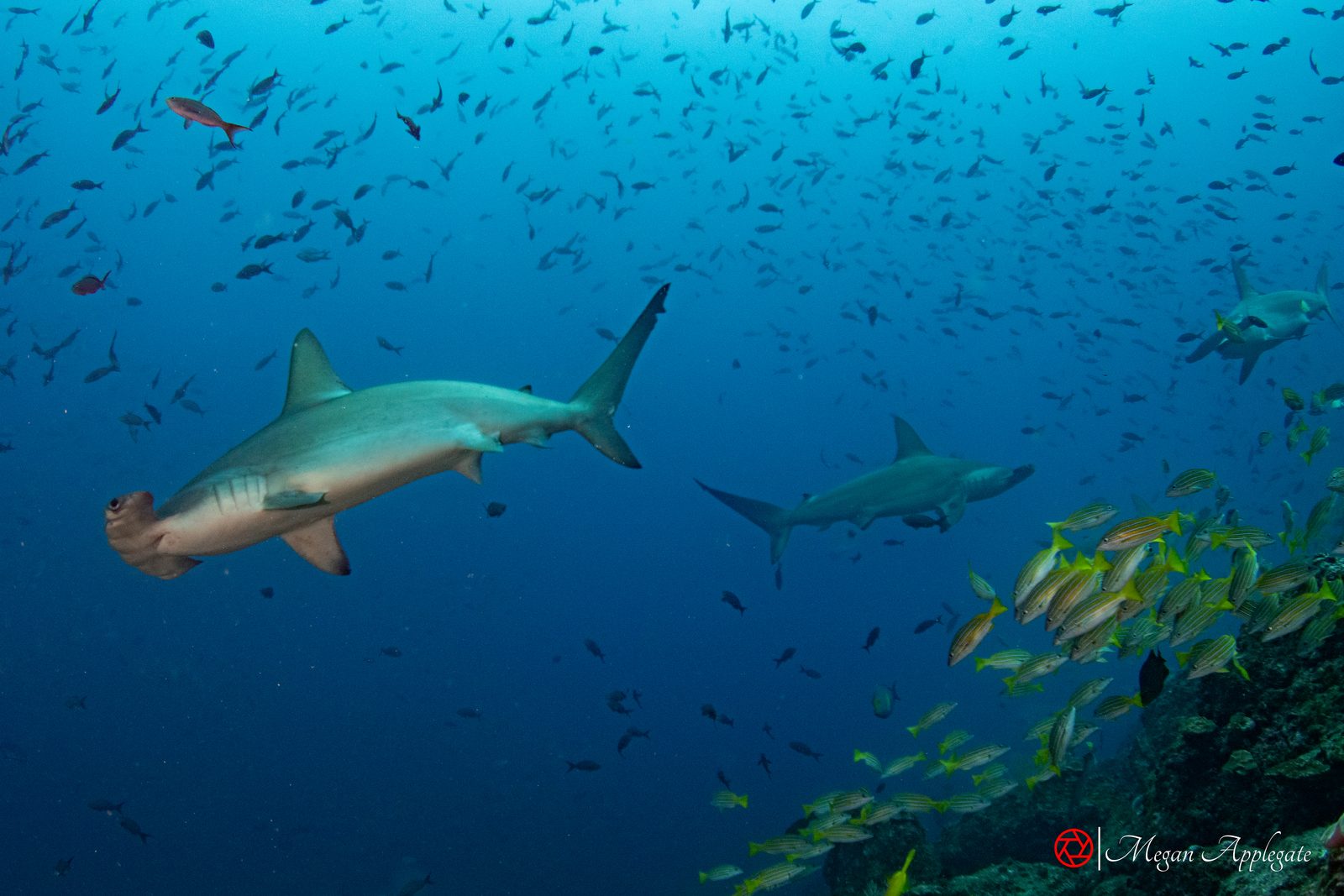
Scalloped hammerhead (Sphyrna lewini)
Scalloped hammerhead. Photo © Megan Applegate, Cocos Island, August 2024.

Scalloped hammerhead Sphyrna lewini

Critically Endangered on the IUCN Red List. A shark of seamounts and offshore islands that gathers in schools by day.

Key marks: The head is flattened into a hammer with a scalloped front edge: a notch in the middle and a shallow scallop either side of it. Eyes at the very tips. Tall, strongly curved first dorsal fin and a small second dorsal. Bronze-grey above, pale below. In open water you usually get the silhouette from below before any colour, so go by the shape of the head.

At Socorro: Schools of hundreds have been reported at the Canyon on San Benedicto (Divernet), where a group was watched at about 27 m (trip report 2001). Cabo Pearce and Roca O’Neal on Socorro are known for them, and they are seen at Roca Partida (Divernet). A cleaning station at Cabo Pearce is at about 27 m; when the water warms they move deeper (DAN).

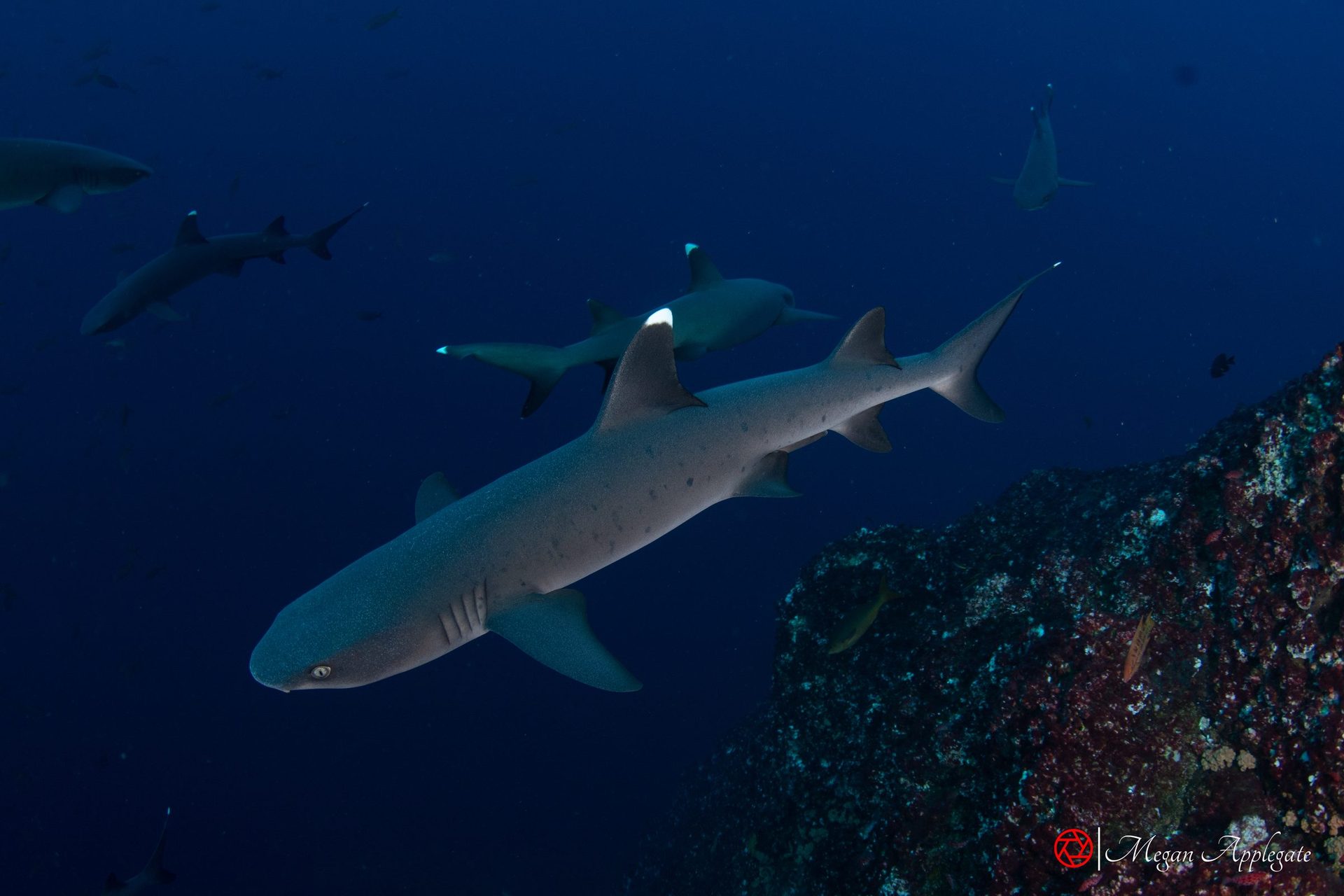
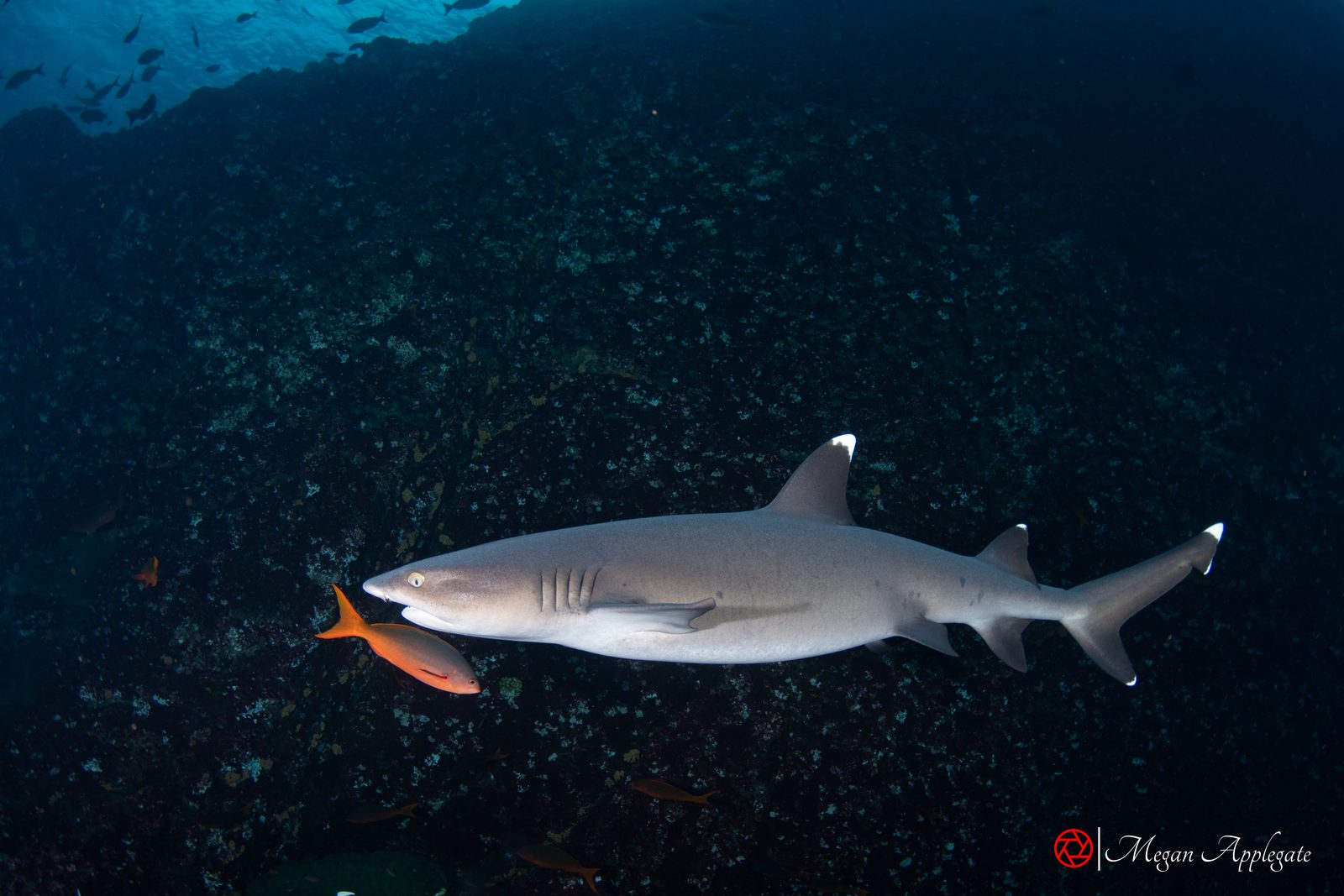
Whitetip reef shark (Triaenodon obesus)
Whitetip reef shark. Photo © Megan Applegate, Socorro, December 2023.

Whitetip reef shark Triaenodon obesus

A slim reef shark with white tips on the first dorsal fin and the upper tail lobe. It spends much of the day resting on the bottom, in caves and under ledges.

Key marks: Small and slim, with a short, blunt snout. A white tip on the first dorsal and on the upper lobe of the tail, often on the lower lobe too. The pectoral fins are plain. Usually lying still on sand or under a ledge during the day. Do not confuse it with the silvertip, which is much bigger, has white edging on all its fins, and does not rest.

At Socorro: Rests by day in recesses on the east side of Roca Partida (Divernet), 8 to 12 sharks to a ledge (DAN); 15 have been counted together (Scuba Diving). Common at the Boiler (DAN). A daytime feeding frenzy was seen at Roca Partida in 2024 (Bluewater 2024).

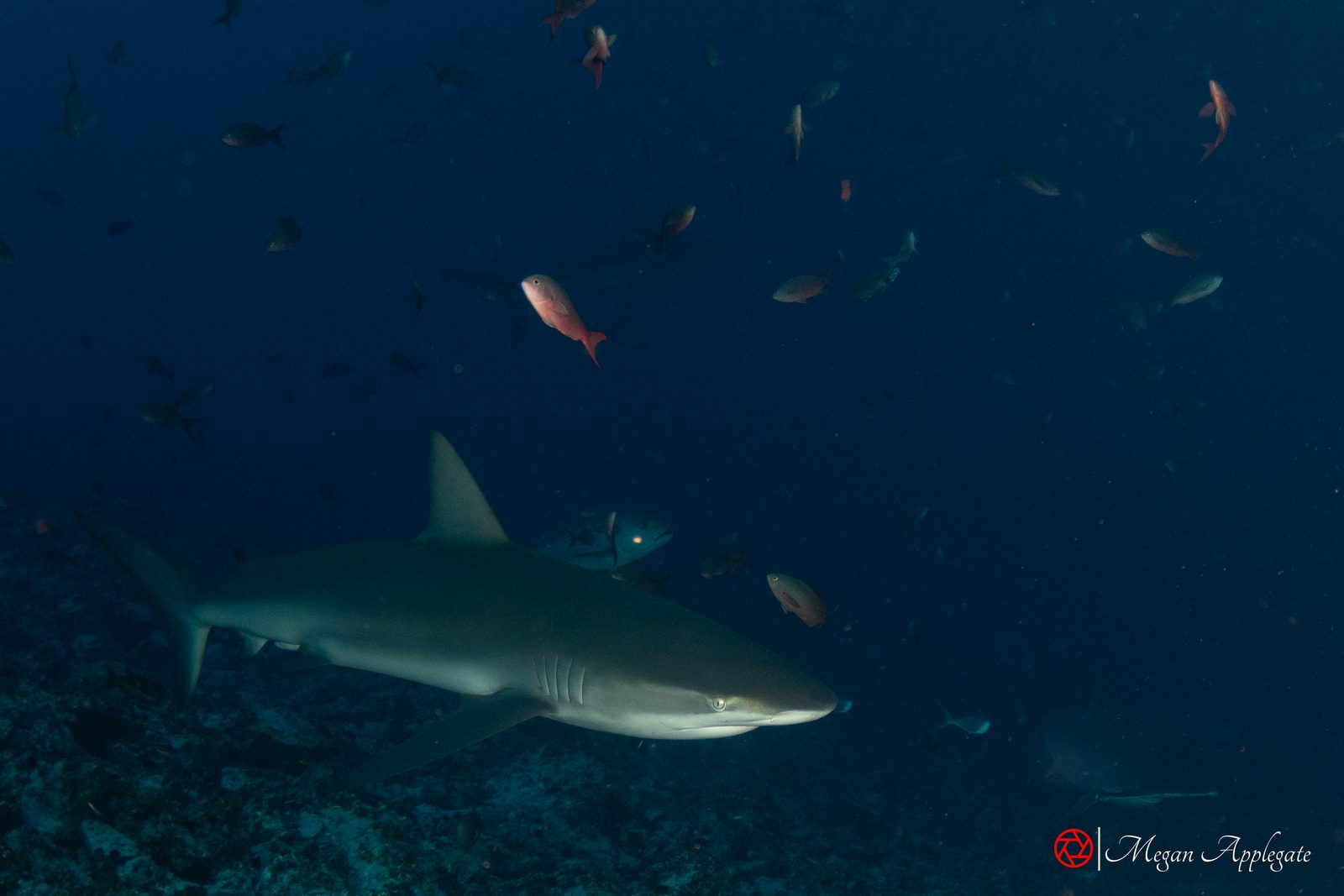
Galápagos shark (Carcharhinus galapagensis)
Galápagos shark. Photo © Megan Applegate, Cocos Island, August 2024.

Galápagos shark Carcharhinus galapagensis

A reef shark of clear water around oceanic islands, commonly about 3 m, with a tall first dorsal fin. Easily confused with the silky shark; see the Shark ID page.

Key marks: Stocky and plain grey-bronze, with a broad, rounded snout and a heavy look to the head and shoulders. The first dorsal is tall and upright and starts roughly above the pectoral tips. A low ridge of skin runs along the back between the two dorsal fins. No strong dark or white fin markings. Works the reef and the walls, and will come in close.

At Socorro: Resident at the Canyon, Roca Partida and Cabo Pearce, and frequent at the Canyon cleaning station (Bluewater 2024). “Big schools” were reported at Roca Partida in December 2001 (trip report 2001); other divers found them shy there (DAN).

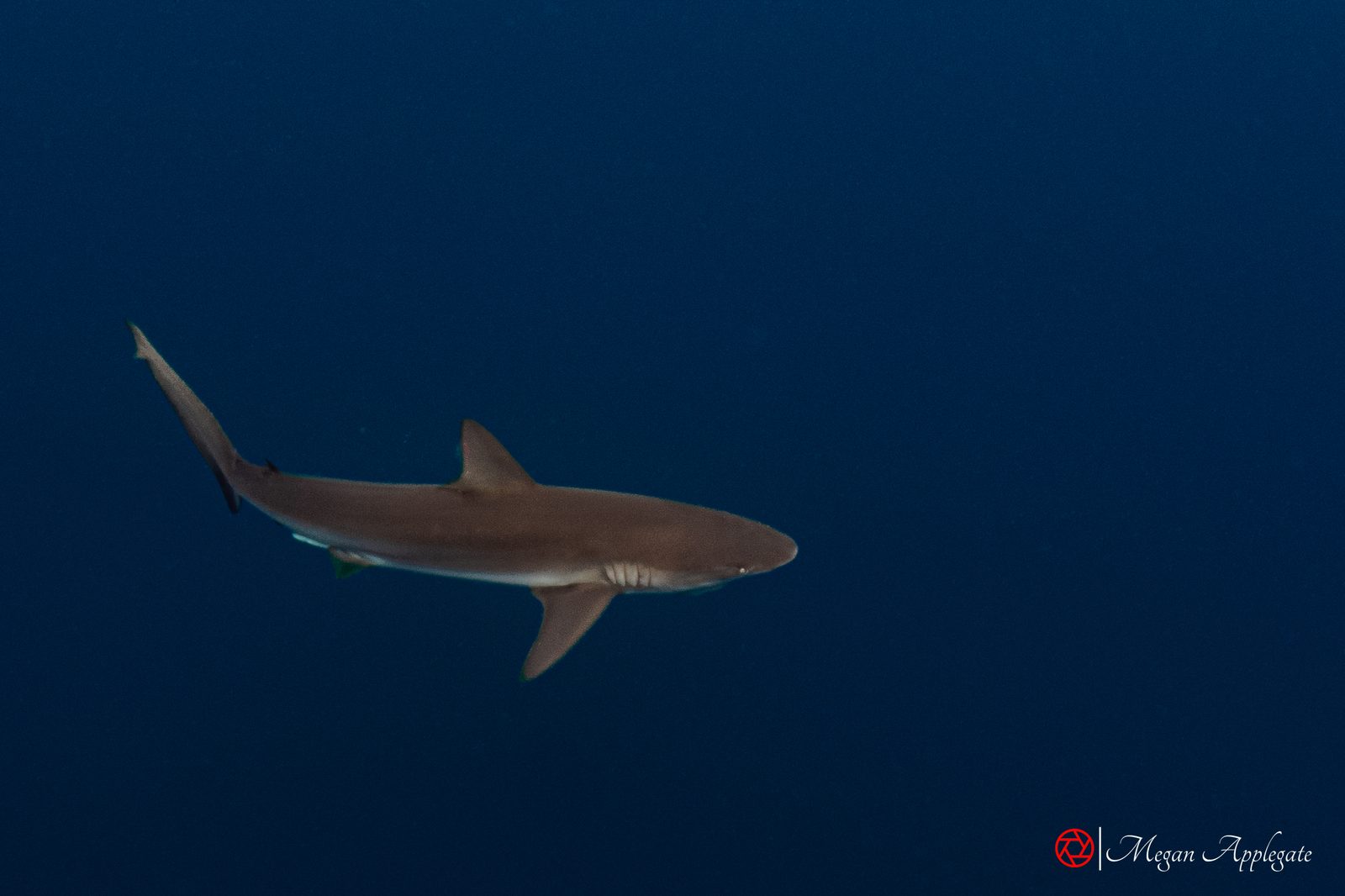
Silky shark (Carcharhinus falciformis)
Silky shark. Photo © Megan Applegate, Cocos Island, August 2024.

Silky shark Carcharhinus falciformis

A slender open-water shark, typically about 2.5 m, named for its fine, smooth skin. Listed as Vulnerable.

Key marks: A very small second dorsal fin with a long, thin trailing tip is the best single mark. The first dorsal is low and rounded and starts behind the pectoral fins. Long, narrow, sickle-shaped pectorals, dusky on the underside of the tips. Slim and smooth, bronze above and white below, usually out in the blue and in numbers.

At Socorro: A resident population at San Benedicto gathers around the dive boats (Divernet). Dozens at Roca Partida (Scuba Diving), in far greater numbers in spring, with the bait balls (DAN).

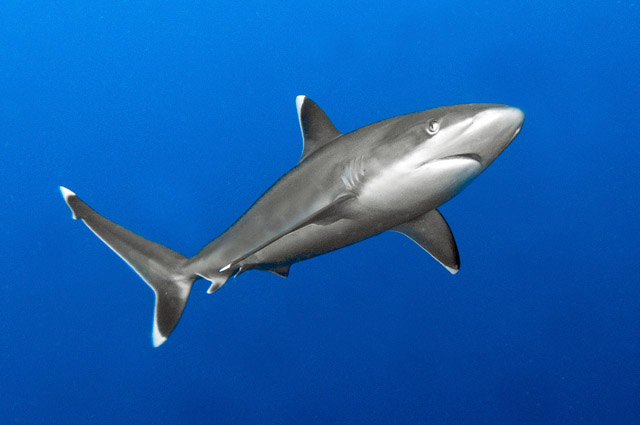
Silvertip shark (Carcharhinus albimarginatus)
Silvertip shark. Photo from FishBase, where the photographer is credited.

Silvertip shark Carcharhinus albimarginatus

A large grey shark with bright white edges on the tips of its fins, which makes it easy to pick out from the grey sharks around it.

Key marks: White edging on almost every fin: the tip of the first dorsal, the tips and trailing edges of the pectorals, and the tail. Larger and bulkier than the whitetip reef shark, with a longer snout, and it keeps cruising off the reef instead of resting on the bottom.

At Socorro: Resident at the Canyon and Roca Partida; in 2024 they circled the Canyon cleaning station at about 26 m (Bluewater 2024). Juveniles were seen at the Canyon in 2001 (trip report 2001).

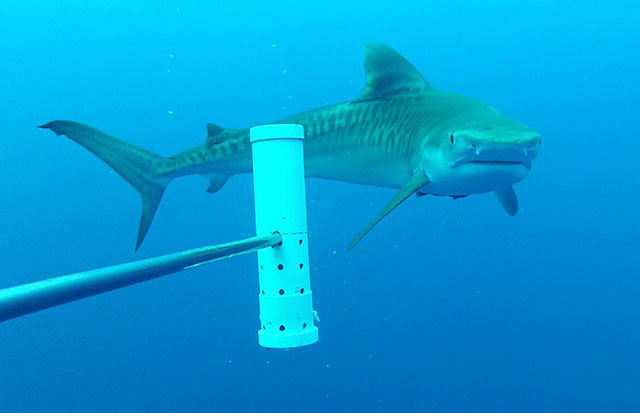
Tiger shark (Galeocerdo cuvier)
Tiger shark. Photo from FishBase, where the photographer is credited.

Tiger shark Galeocerdo cuvier

A large shark with a blunt, square snout. Young animals have dark vertical stripes that fade with age.

Key marks: A very blunt, square snout on a broad head. Dark vertical bars and blotches down the flanks, strong on young animals and faded on big adults. Heavy-bodied, with a long upper tail lobe.

At Socorro: Reported at Punta Tosca, one over 3 m long (Scuba Diving), at the Boiler and the Canyon (Bluewater 2020), and at the surface at Cabo Pearce (Bluewater 2024).

Blacktip shark Carcharhinus limbatus

A fast, slim requiem shark with crisp black fin tips.

Key marks: Black tips on the first dorsal, the pectorals and the lower lobe of the tail, on a slim body with a long pointed snout. The anal fin tip stays pale, which is what separates it from the blacktip reef shark.

At Socorro: Reported at El Cañón on San Benedicto (Scuba Diving).

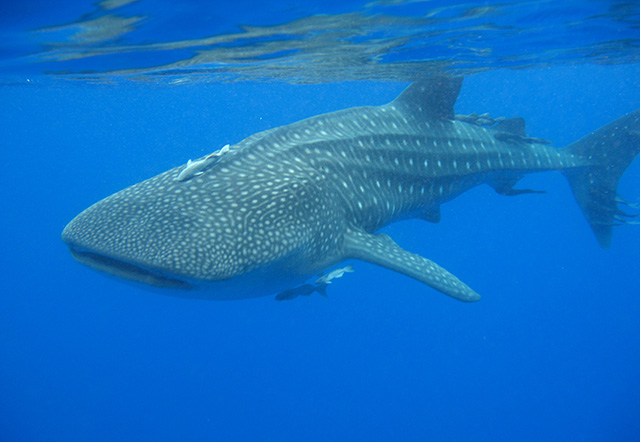
Whale shark (Rhincodon typus)
Whale shark. Photo from FishBase, where the photographer is credited.

Whale shark Rhincodon typus

The largest fish in the world, a filter feeder that is harmless to divers. Listed as Endangered.

Key marks: Unmistakable. Very large, with a broad flat head and a wide mouth right at the front of the snout rather than slung underneath. Dark grey-blue with a chequerboard of pale spots and bars, and three ridges running the length of each flank. The spot pattern is unique to each animal, which is how researchers tell them apart.

At Socorro: One dive operator gives November and December as the peak (Bluewater Dive Travel); another account puts them in April and May (DAN). Seen at Roca Partida (Divernet), the Boiler (trip report 2001) and Cabo Pearce (Wetpixel).

Rays

The giant mantas

The reason most divers come

Mantas have their own page

The giant oceanic mantas, the main reason most divers come to Socorro, are on the Mantas page: colour forms, the population, where to see them and how to behave around them.

Also listed

Reported once, or listed without detail

Possible but unconfirmed

Possible but unconfirmed on dives

A dusky shark was reported at Roca Partida, and a small electric ray at the Canyon, on a December 2001 trip (trip report 2001). Up to 20 shark species are recorded in the archipelago (UNESCO), and 37 species of sharks and rays (Pew 2018), so others are possible.

At a glance

Sharks and mantas at Socorro

Where and when, in one table

Table — Sharks and mantas in the Revillagigedo Islands, from DAN, Divernet, Scuba Diving, Bluewater Dive Travel and Wetpixel. The dive season runs November to May; individual trips vary.
SpeciesWhere reportedWhen
Giant oceanic mantaThe Boiler, El Cañón, Cabo Pearce, Punta Tosca, Roca PartidaAll season
Scalloped hammerheadThe Canyon, Cabo Pearce, Roca O’Neal, Roca PartidaAll season
Whitetip reef sharkRoca Partida ledges, the BoilerAll season
Galápagos sharkThe Canyon, Roca Partida, Cabo PearceAll season
Silky sharkSan Benedicto, Roca PartidaAll season; more in spring
Silvertip sharkThe Canyon, Roca PartidaAll season
Tiger sharkPunta Tosca, the Boiler, the Canyon, Cabo PearceOccasional
Blacktip sharkEl CañónOccasional
Whale sharkRoca Partida, the Boiler, Cabo PearceNov–Dec or Apr–May, by source

Diving here

The islands are reached only by liveaboard, about 24 hours from Cabo San Lucas or San José del Cabo. Currents can be strong, seas choppy and walls steep; the diving is recommended for experienced divers, and a whistle and a surface marker buoy are carried on every dive (Divernet). The Shark ID page shows how to tell the grey sharks apart.