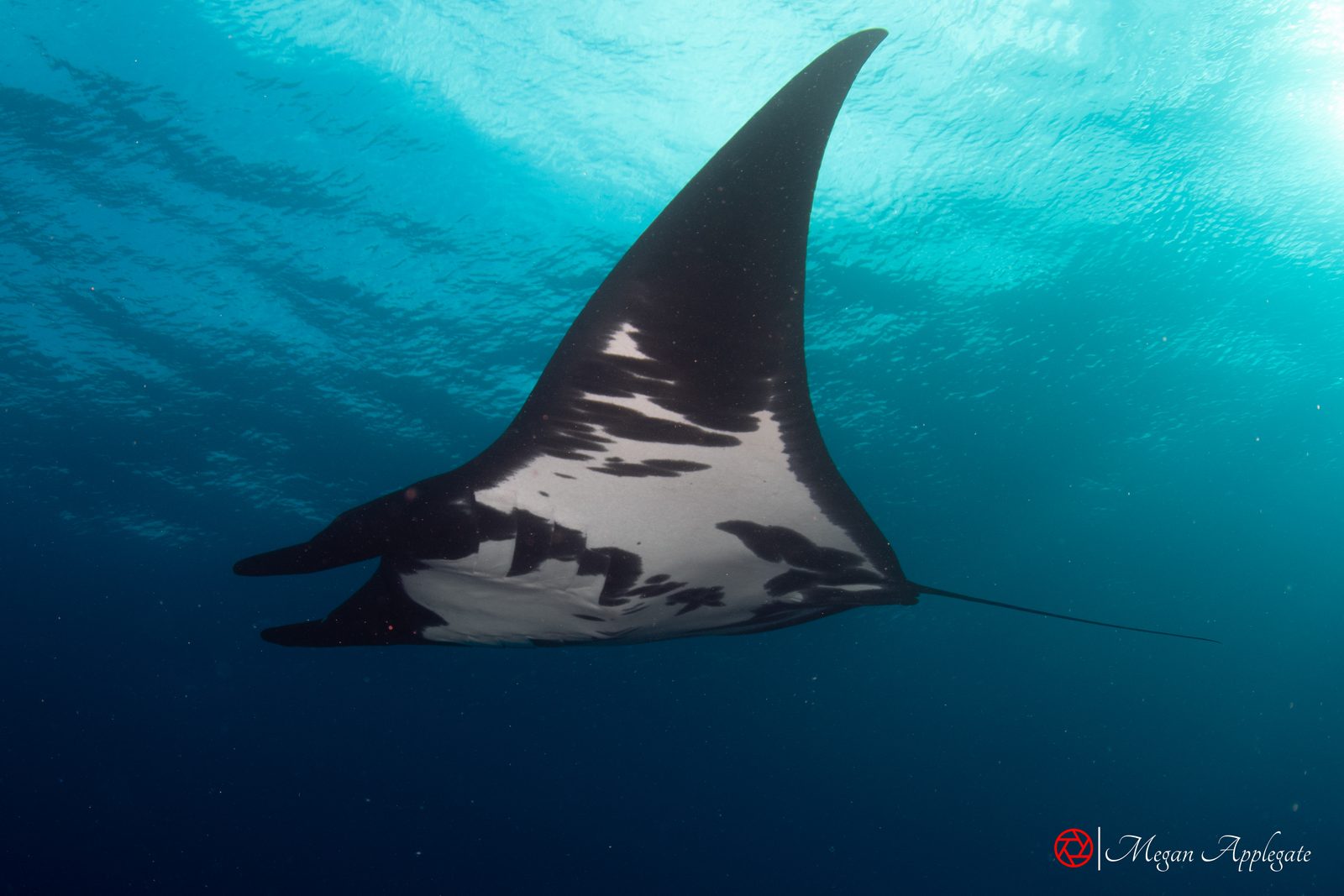
Chevron form Mobula birostris
Black on the back with two white shoulder patches that form a “T”, and a white belly (Wikipedia). About three in four mantas here look like this (Manta Trust 2020).
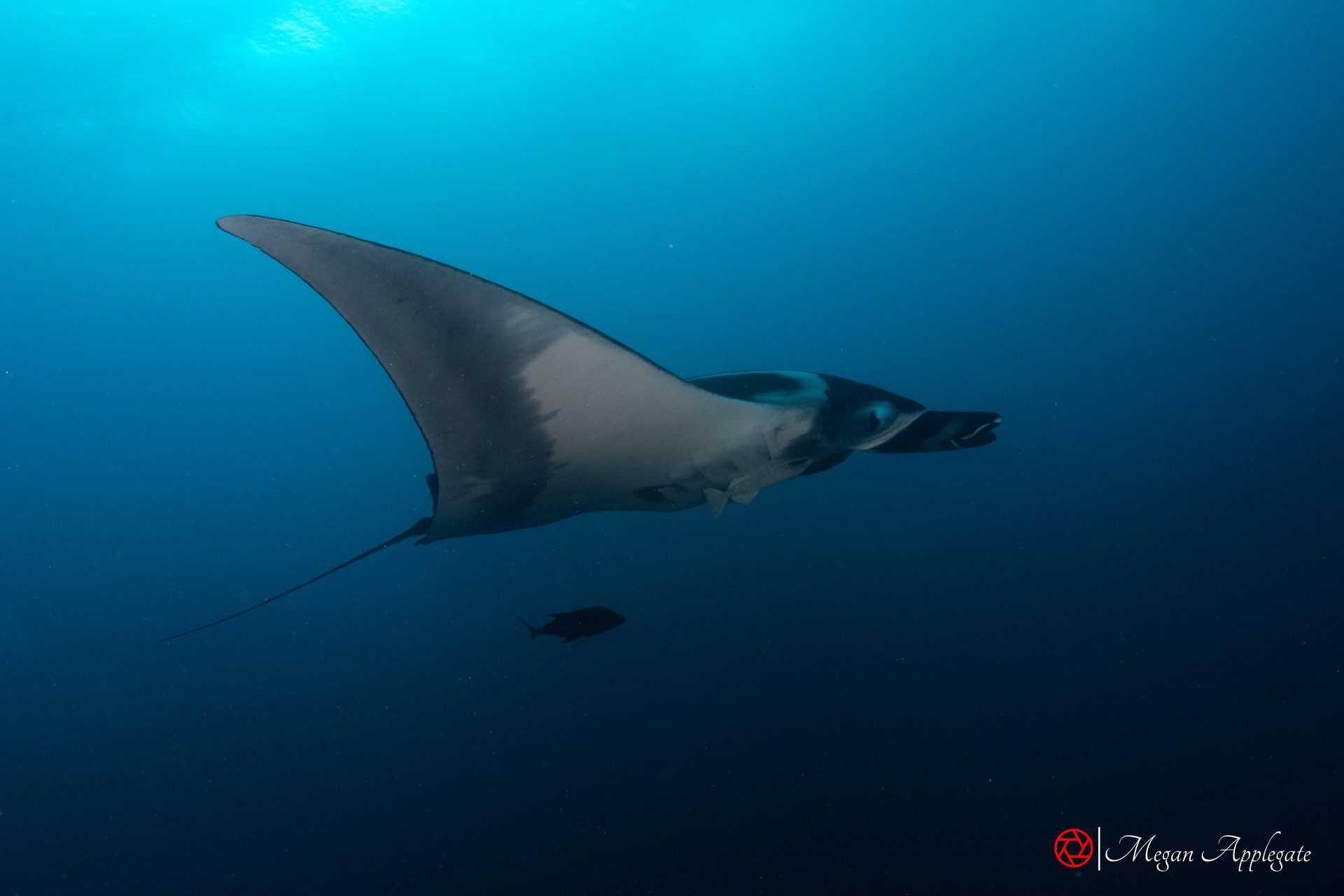
Mantas
The giant oceanic mantas of the Revillagigedo Islands: how to tell the colour forms apart, what is known about the population, where to find them and how to behave when they come to you.
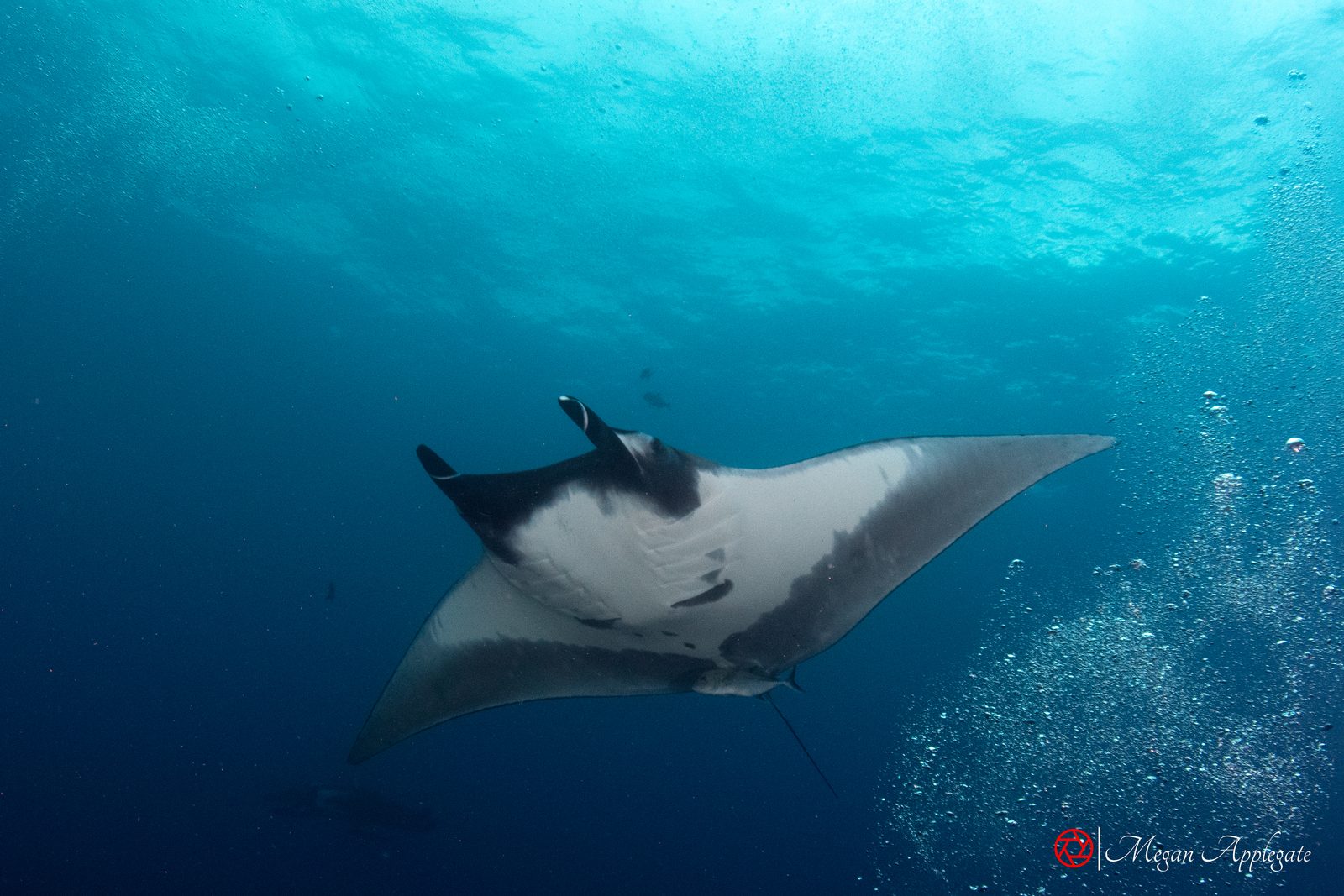
Background photo: Megan Applegate (Socorro)
The animal
Biggest ray, biggest fish brain
The largest ray in the world, with a disc up to about 7 m across and a weight of around 3,000 kg (Wikipedia). It has the largest brain of any fish, up to about 200 g (Wikipedia).
It filters zooplankton such as copepods and krill, and much of its diet turns out to come from deep water (Wikipedia). A female has a single pup after about a year’s pregnancy, and breeds only every two to three years (Wikipedia), so populations recover slowly. The species is listed as Endangered on the IUCN Red List, mainly because of fishing (Wikipedia).
| Giant oceanic manta | |
|---|---|
| Disc width | Up to about 7 m |
| Weight | Around 3,000 kg |
| Young | One pup every 2–3 years |
| Food | Zooplankton |
| IUCN status | Endangered |
Telling them apart
Chevron, black and the belly
About a quarter of the mantas seen at the Revillagigedo Islands are black (Manta Trust 2020). Oceanic mantas are also bigger than reef mantas, typically 4–5 m across against 3–3.5 m (Wikipedia).
Black on the back with two white shoulder patches that form a “T”, and a white belly (Wikipedia). About three in four mantas here look like this (Manta Trust 2020).
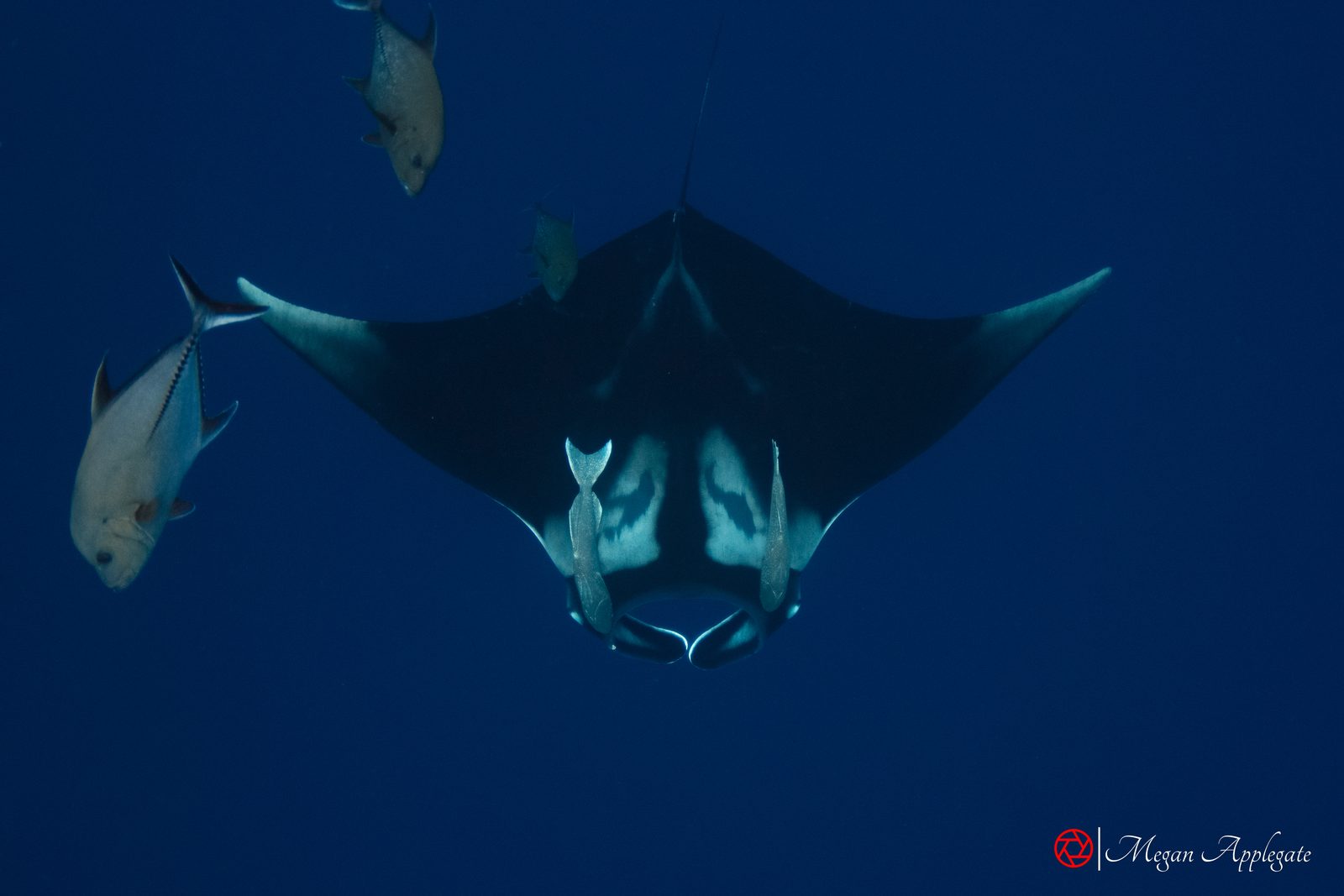
Almost entirely black, above and below. It is a colour form caused by extra dark pigment, not a separate species (Manta Trust 2020).
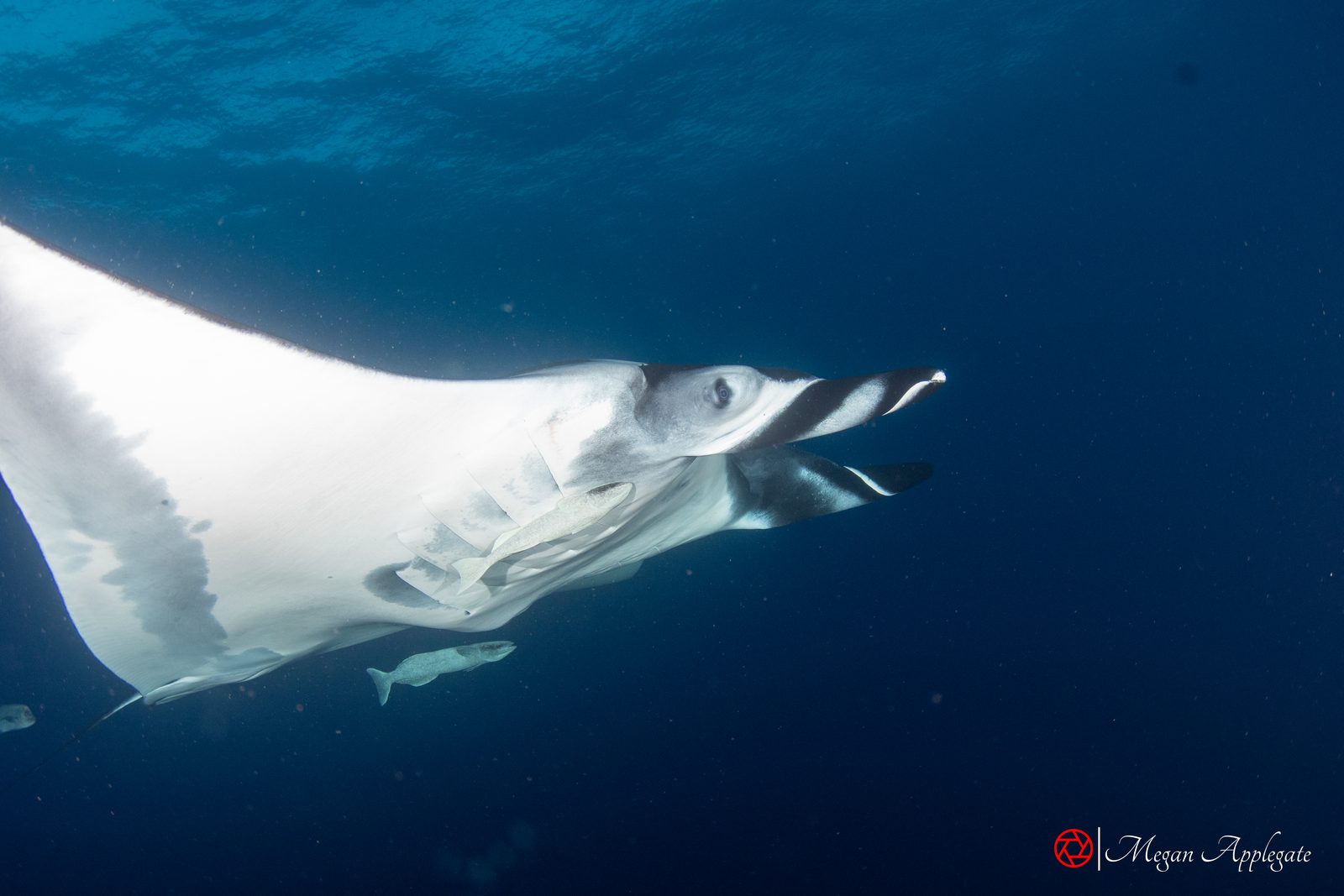
In the oceanic manta the dark spots sit low on the belly, and the inside of the mouth is often black (Wikipedia). Researchers identify individual mantas from photos of their markings (Manta Trust 2020).
The population
Known one by one, for decades
The Pacific Manta Research Group has kept a photo-identification catalogue of these mantas since 1978, and has identified more than 1,300 individuals; over 500 of them have been seen more than once. One manta has been re-sighted after 29 years, a longevity record for the species (Manta Trust).
A study of photo-ID records from 2015 to 2019 estimated that about 1,172 mantas used the park in those years, with about 1.4 females for every male; their survival rose and fell with El Niño (Cabral et al. 2022). The population was one of the reasons the islands became a UNESCO World Heritage Site in 2016 (Manta Trust 2020).
Share your manta photos
The research group has no boat of its own and relies on divers’ photos (Manta Trust 2020). A clear photo of a manta’s belly, with the date and site, can be added to the catalogue (Manta Trust).
Where
All season, November to May
Mantas are seen throughout the liveaboard season, November to May (Bluewater Dive Travel).
The best-known manta site: a pinnacle where Clarion angelfish clean the mantas, often with bottlenose dolphins nearby (Divernet; Divernet).
A cleaning station at about 23 m that mantas often visit (Scuba Diving).
Divers wait at a cleaning station on the ridge, out of the current, while the mantas pass overhead (Scuba Diving); Clarion angelfish clean them on the ridge top at about 8 m (DAN).
Cleaning stations near the southern tip of Socorro (Divernet); a chain of three mantas circled one group of divers for nearly ten minutes (Scuba Diving).
Mantas pass in open water; an all-black manta was seen here in February 2024 (Bluewater 2024).
In the water
Let them come to you
The mantas here are famous for coming to divers. They hover overhead and pause to bathe in the exhaust bubbles (Divernet; DAN).
How to behave
Touching the mantas is no longer allowed. Don’t chase them; stay calm and let them start any close encounter, and they tend to return for pass after pass (Divernet).