Sharks & rays

Palau sharks & rays

The sharks and rays of the world’s first shark sanctuary: grey reef sharks on the corners, whitetips on the ledges and reef mantas at the cleaning stations, with where and when to look and the marks that tell them apart.

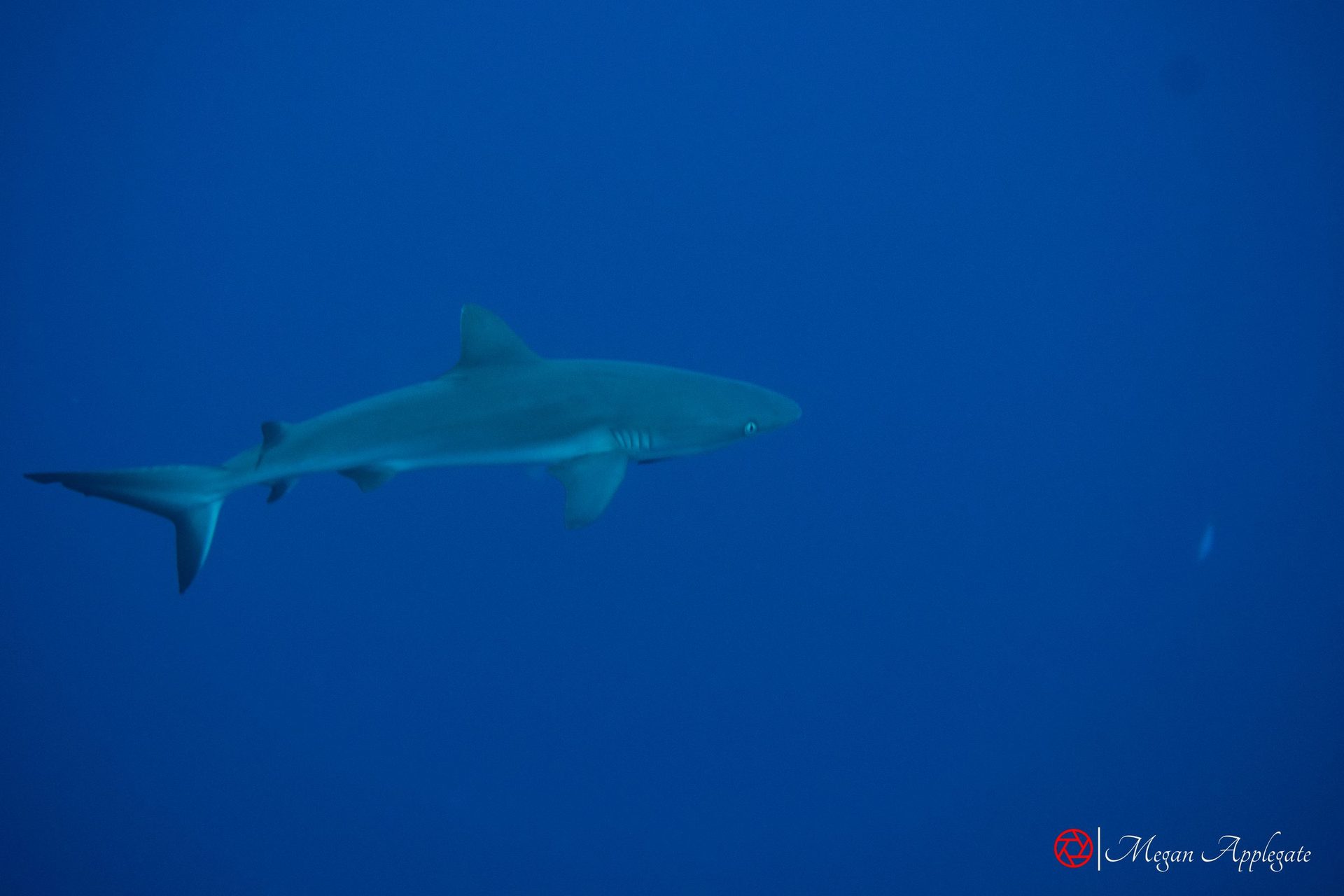
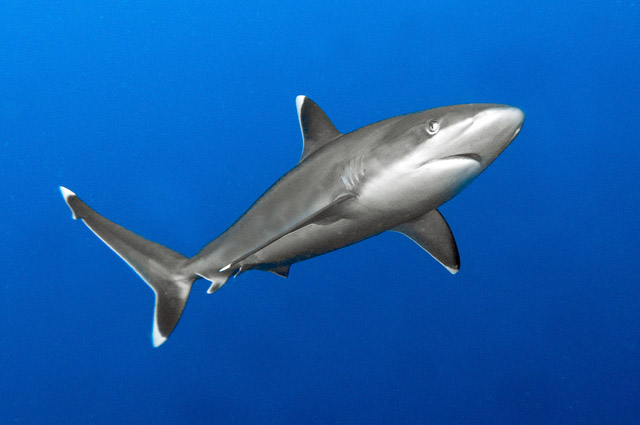
Grey reef shark (Carcharhinus amblyrhynchos)
Grey reef shark. Photo © Megan Applegate, Palau, January 2023.

Background photo: Megan Applegate (Palau)

Sharks

The reef sharks

4 species · key marks on each

In 2009 Palau made all its waters the world’s first shark sanctuary (Pew 2015). Grey reef and whitetip reef sharks are the ones most divers meet: they were seen on most dives at the five most popular shark sites (Pew / AIMS 2011).

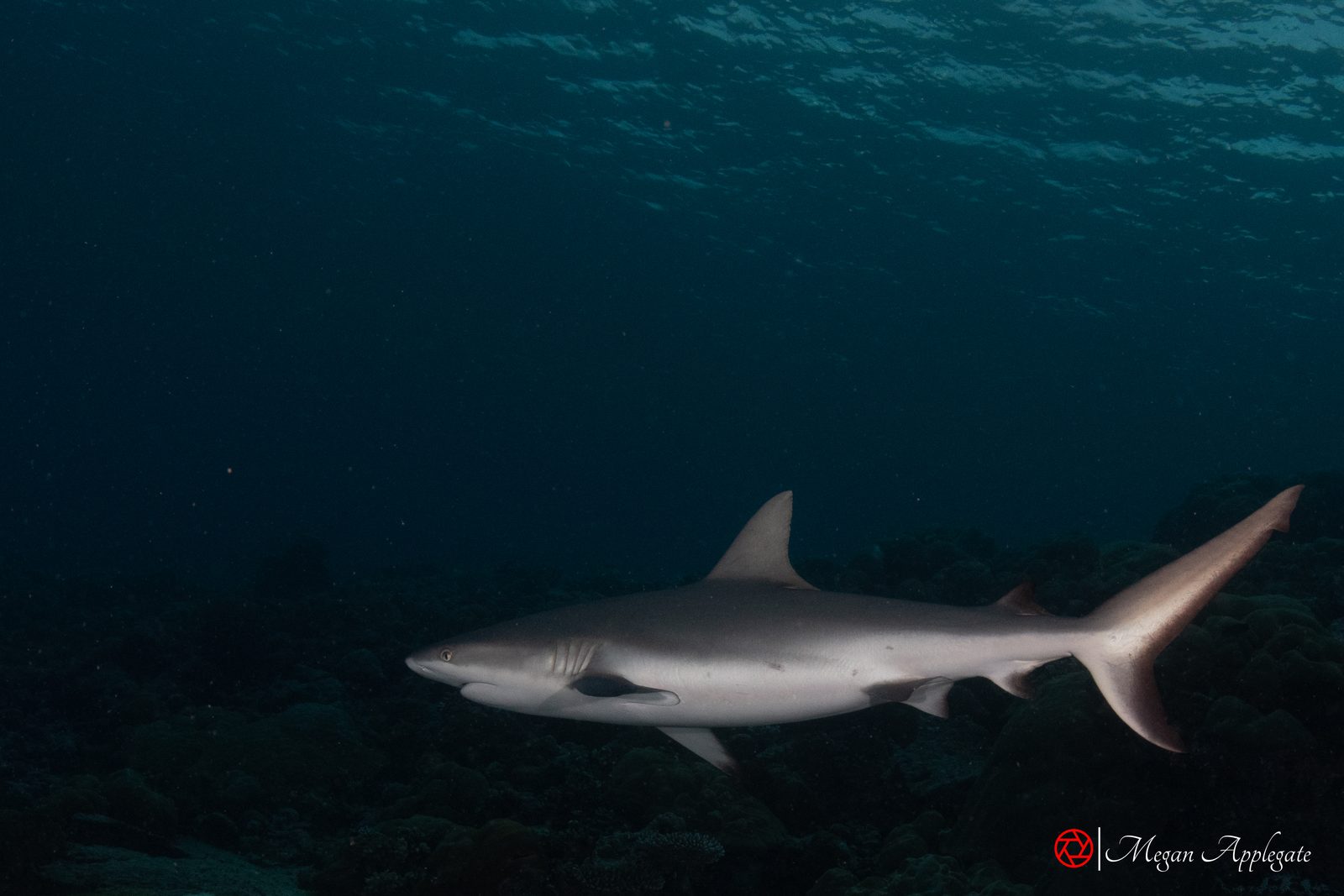
Grey reef shark (Carcharhinus amblyrhynchos)
Grey reef shark. Photo © Megan Applegate, Palau, January 2023.

Grey reef shark Carcharhinus amblyrhynchos

A stocky reef shark, most under 1.9 m long, with a broad, rounded snout. Listed as Endangered on the IUCN Red List (Wikipedia).

Key marks: A broad black band along the whole trailing edge of the tail. In the Pacific the first dorsal fin is plain grey, while the other fins have dusky to black tips (Wikipedia). A shark that hunches, raising its snout, dropping its pectoral fins and swimming stiffly from side to side, is making a threat display, usually at a diver who approached or followed it (Wikipedia): back away.

At Palau: The shark of Palau’s current-swept corners. Around Blue Corner and the nearby walls they were seen on 86% of dives in 2007–2012, in groups of 10–80, and 100–200 gathered at Blue Corner to feed in several Decembers and Januaries (ISRA Ngemelis). More than 200 fed on spawning Moorish idols at Siaes Corner in January 2017 (ISRA Siaes Corner). Females with fresh mating scars are seen mainly from December to April (ISRA Ngemelis), and groups of up to 150 young sharks gather at Ulong (ISRA Ulong). One study valued a single reef shark at about US$1.9 million to Palau’s tourism over its life (Pew / AIMS 2011).
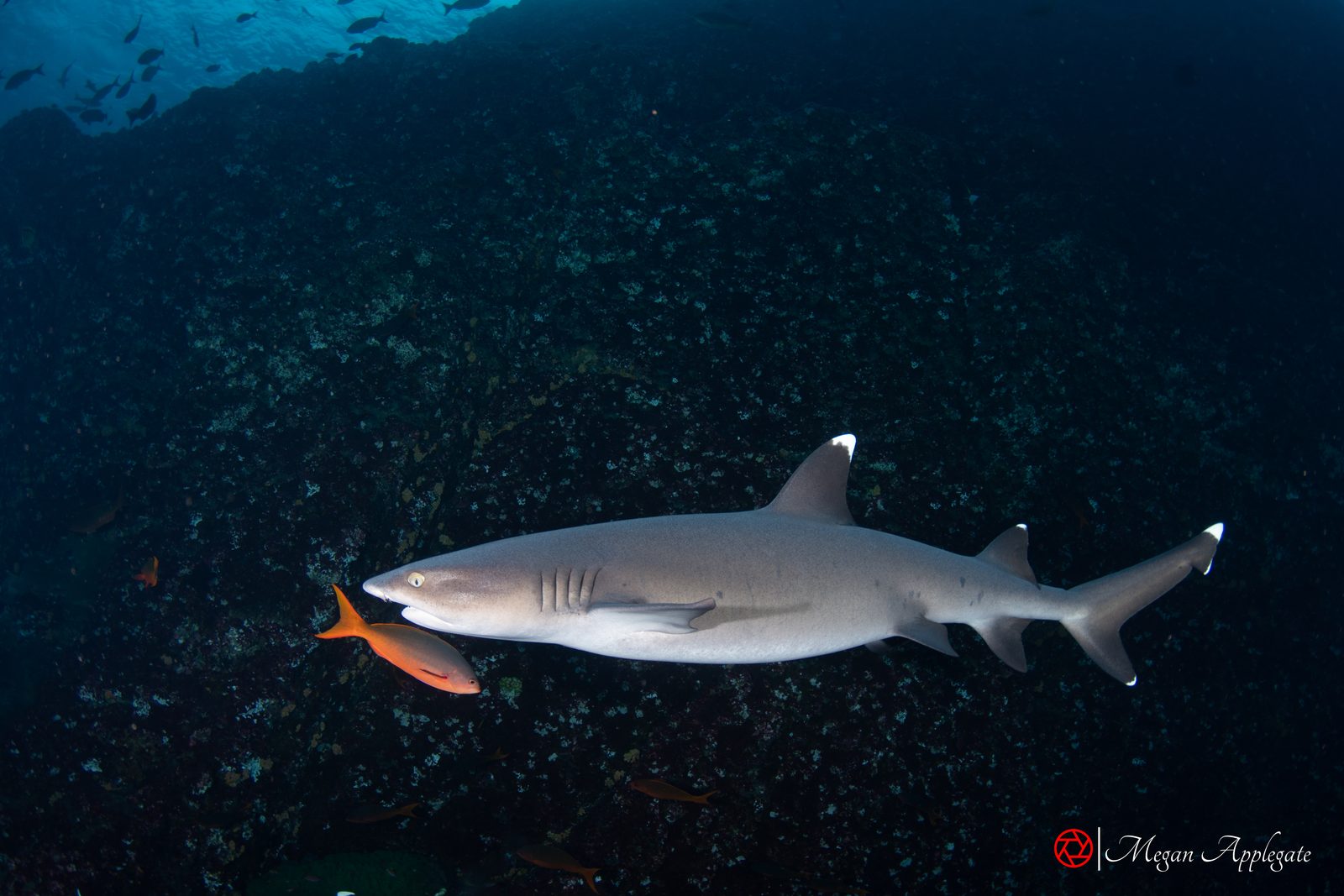
Whitetip reef shark (Triaenodon obesus)
Whitetip reef shark. Photo © Megan Applegate, Socorro, Mexico, December 2023.

Whitetip reef shark Triaenodon obesus

A slim, fairly small reef shark with white tips on the first dorsal fin and the upper tail lobe. It spends much of the day resting on the bottom, in caves and under ledges.

Key marks: Small and slim, with a short, blunt snout. A white tip on the first dorsal and on the upper lobe of the tail, often on the lower lobe too. The pectoral fins are plain. Usually lying still on sand or under a ledge during the day. Do not confuse it with the silvertip, which is much bigger, has white edging on all its fins, and does not rest.

At Palau: Rests on the reef in groups of 2–10 around Blue Corner and the Ngemelis walls, mostly at 15–35 m (ISRA Ngemelis); at Siaes Corner 2–6 rest on the plateau at 15–25 m on 90% of dives (ISRA Siaes Corner). Courtship has been seen at Ulong in September and October (ISRA Ulong).

Blacktip reef shark Carcharhinus melanopterus

A small shark of shallow reefs, usually 1.6 m or less, often in only a few metres of water near shore. Vulnerable on the IUCN Red List (Wikipedia).

Key marks: Crisp black tips on the fins, boldest on the first dorsal and the lower lobe of the tail and set off by a paler border; a white band runs along the side from above the anal fin (Wikipedia).

At Palau: Listed among the sharks of Blue Corner and the Ngemelis walls (ISRA Ngemelis) and of Ulong (ISRA Ulong).

Silvertip shark (Carcharhinus albimarginatus)
Silvertip shark. Photo from FishBase, where the photographer is credited.

Silvertip shark Carcharhinus albimarginatus

A large grey shark with bright white edges on the tips of its fins, which makes it easy to pick out from the grey sharks around it.

Key marks: White edging on almost every fin: the tip of the first dorsal, the tips and trailing edges of the pectorals, and the tail. Larger and bulkier than the whitetip reef shark, with a longer snout, and it keeps cruising off the reef instead of resting on the bottom.

At Palau: Listed among the sharks of Blue Corner, the Big Drop-off and the New Drop-off (ISRA Ngemelis).

Rays

Mantas and stingrays

Reef mantas at the cleaning stations

Reef manta Mobula alfredi

A manta of coasts and reefs, typically 3–3.5 m across and up to about 5.5 m, smaller than the giant oceanic manta. Vulnerable on the IUCN Red List (Wikipedia).

Key marks: Seen from above, the pale shoulder patches blend softly into the dark back and the gap between them forms a “Y”, not the sharp-edged “T” of the oceanic manta. Underneath, dark spots sit between the gill slits and along the trailing edges of the fins and belly (Wikipedia).

At Palau: German Channel is the classic site, with a cleaning station at about 20 m (PADI). In the Ngemelis channel area 235 different mantas were photo-identified in 2010–2013; groups of 3–5 are usual, up to 20 when a strong incoming current runs, and 15–25 feed together around the full moon from November to January (ISRA Ngemelis Channel). On the western barrier reef, “Devilfish City” in Ngardmau has feeding groups from January to May, peaking at 40–50 in April and May; Palau’s largest gathering, more than 70 mantas, was recorded there (ISRA Ngardmau Passage).

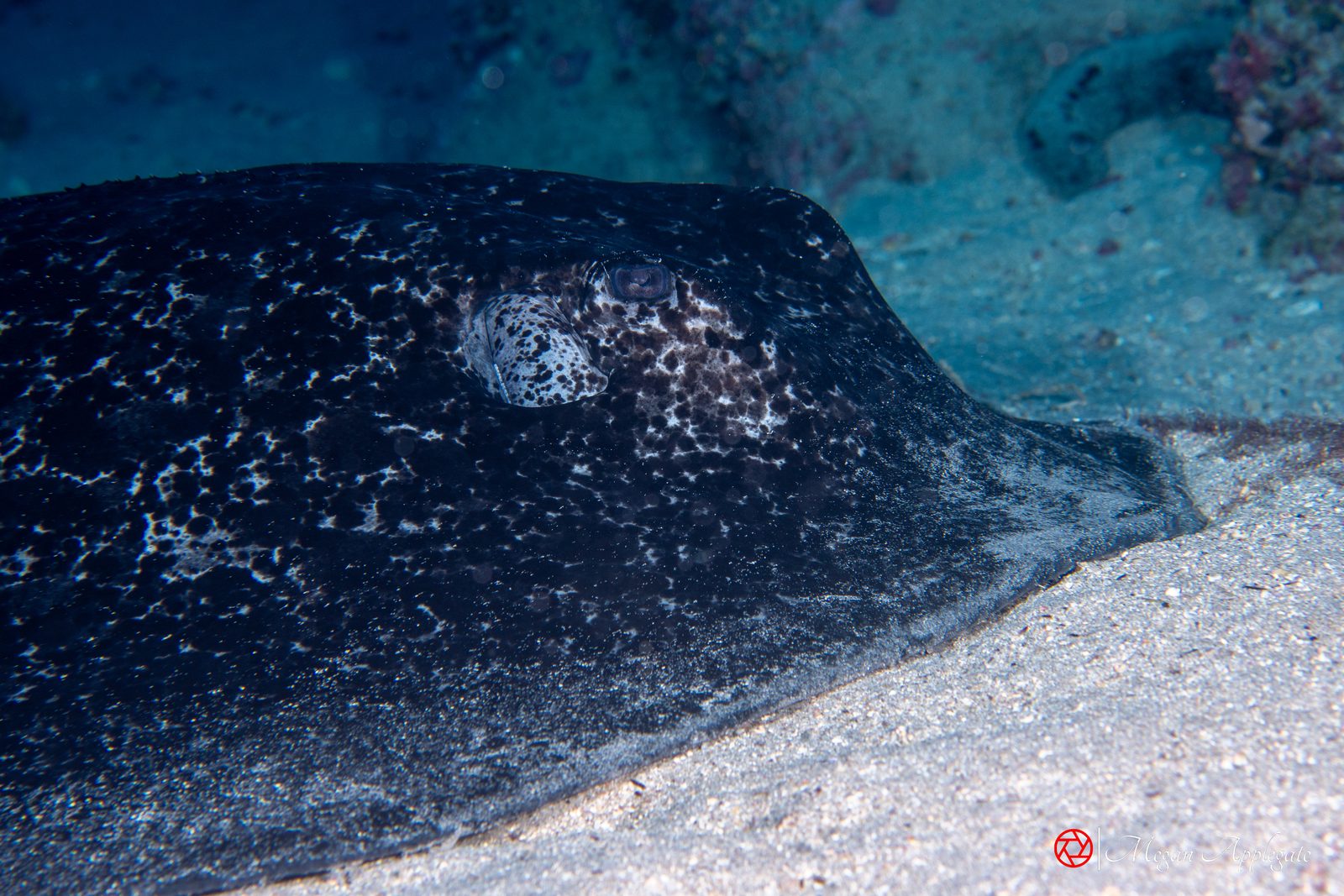
Blotched fantail ray (marbled ray) (Taeniurops meyeni)
Blotched fantail ray (marbled ray). Photo © Megan Applegate, Cocos Island, August 2024.

Blotched fantail ray (marbled ray) Taeniurops meyeni

Key marks: A broad, rounded, thick disc, grey with dense dark mottling, and a tail shorter than the disc with a deep fin fold underneath. Usually resting on sand or under ledges.

At Palau: Listed among the rays of Blue Corner and the Ngemelis walls (ISRA Ngemelis) and of Ulong (ISRA Ulong). Vulnerable on the IUCN Red List (ISRA Ngemelis).

What a manta is worth

In a 2015 Manta Trust study, visitors to German Channel had about a 40% chance of seeing a manta, in a season the study called very poor, and one resident manta was estimated to be worth about US$34,096 to tourism in a single high season (Manta Trust (Prieto 2015)).

Also reported

Seen less often

Possible but unconfirmed on most dives

Other sharks and rays

At Ulong, sicklefin (sharptooth) lemon sharks and blacktip sharks, 2–4 of each, join the grey reef sharks feeding on spawning camouflage groupers; tawny nurse sharks, Indo-Pacific leopard sharks and broad cowtail rays are also listed there (ISRA Ulong). At Peleliu Corner about four bull sharks and 2–10 blacktip sharks are recorded each year (ISRA Peleliu Corner).

The spotted eagle ray is listed around Blue Corner (ISRA Ngemelis). Occasional hammerheads and mantas pass Blue Corner, and tiger sharks, hammerheads and whale sharks have been reported along Peleliu (Dive The World); scalloped hammerheads are a reason for early-morning dives at Peleliu Cut (Palau Dive Adventures). At least 13 species of sharks and manta rays are recorded in the Rock Islands Southern Lagoon (UNESCO).

At a glance

Sharks and rays at Palau

Where and when, in one table

Table — Sharks and rays at Palau, from the ISRA factsheets, PADI and Dive The World. Individual dives vary.
SpeciesWhere reportedWhen
Grey reef sharkBlue Corner, Siaes Corner, Ulong, Peleliu Corner, the drop-offsAll year; mating Dec–Apr
Whitetip reef sharkBlue Corner, Ngemelis walls, Siaes Corner, UlongAll year
Blacktip reef sharkBlue Corner area, UlongAll year
Silvertip sharkBlue Corner, Big and New Drop-offOccasional
Reef mantaGerman Channel; Devilfish City (Ngardmau)Nov–Jan feeding at German Channel; Jan–May at Ngardmau
Blotched fantail rayBlue Corner area, UlongAll year

Diving here

The shark sites are current dives: strong currents are common at Blue Corner, Ulong and Peleliu, and divers use reef hooks to hold position at the corners (Dive The World; Palau Dive Adventures). Palau has no recorded fatal shark attack in its history (DAN Alert Diver).