Turtles

Palau turtles

Hawksbill and green turtles: how to tell them apart, where they nest and where divers meet them, and how Palau protects them.

Hawksbill turtle (Eretmochelys imbricata)
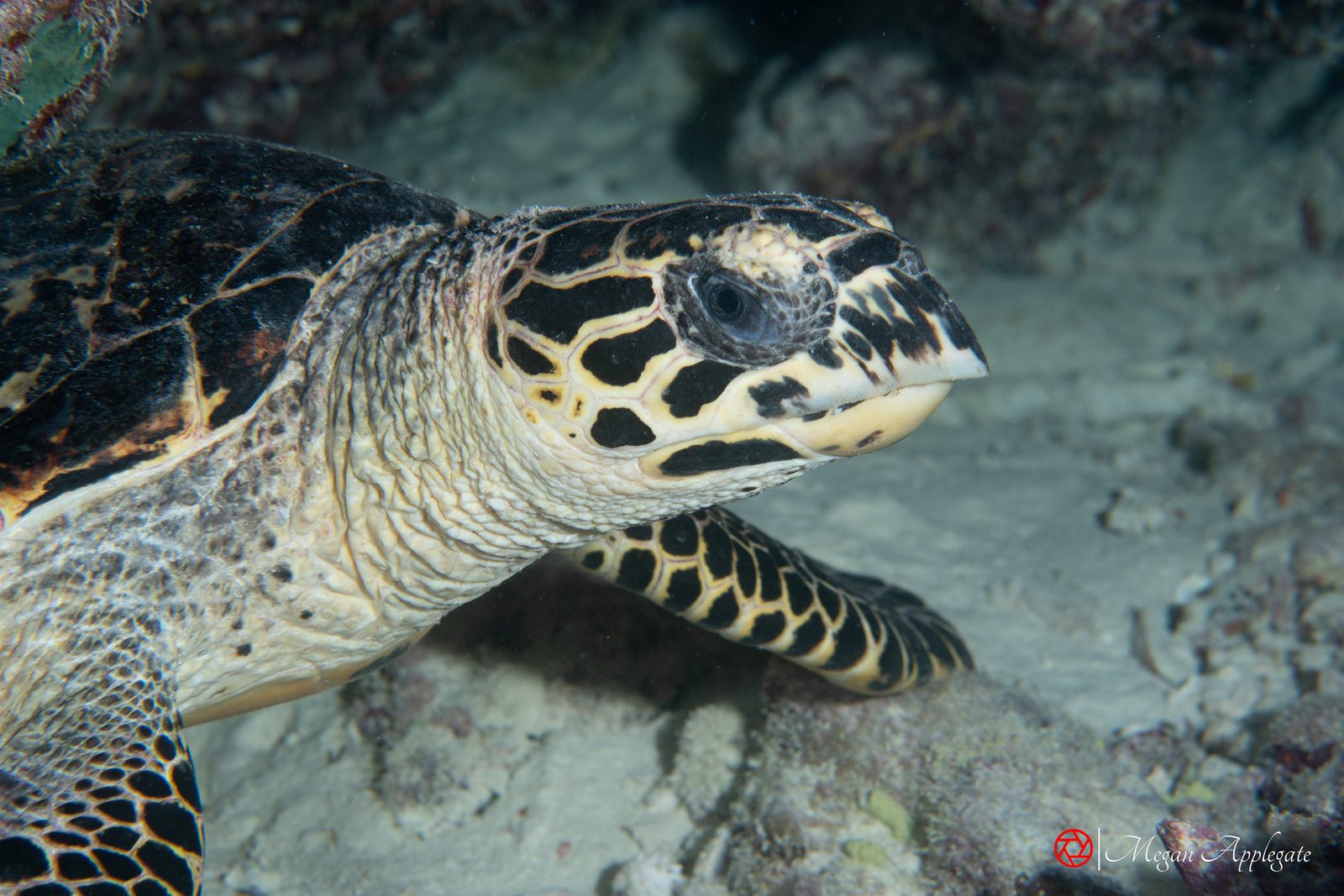
Hawksbill turtle. Photo © Megan Applegate, Palau, January 2023.

Background photo: Megan Applegate (Palau)

The turtles

Hawksbill and green turtles

The two turtles divers meet

Hawksbill and green turtles are the two sea turtles that nest in Palau and have been the most harvested; olive ridleys have also been caught and released around the main islands (Marine Turtle Newsletter 2007).

Hawksbill turtle (Eretmochelys imbricata)
Hawksbill turtle. Photo © Megan Applegate, Palau, January 2023.

Hawksbill turtle Eretmochelys imbricata

Adults are typically about 1 m long and weigh about 80 kg, and sponges make up 70–95% of their diet. Critically Endangered on the IUCN Red List: numbers are thought to have fallen by 80% in the past 100–135 years (Wikipedia).

Key marks: A narrow head with a sharp, hooked beak; thick, overlapping shell plates that give the back edge of the shell a saw-toothed look; two claws on each front flipper (Wikipedia).

At Palau: Nests mainly in the Rock Islands Southern Lagoon (Marine Turtle Newsletter 2007). Divers meet hawksbills on the Big Drop-off, at Blue Corner and around the wreck of the Iro near Peleliu (Dive The World).

Green turtle Chelonia mydas

The largest hard-shelled sea turtle (National Geographic). Adults reach about 1.5 m and 68–190 kg and eat mainly seagrass. In October 2025 the IUCN moved the global population from Endangered to Least Concern, though some populations remain at risk (Wikipedia).

Key marks: A very short snout with an unhooked beak, a single pair of scales on top of the head in front of the eyes, and, in adults, one claw on each front flipper (Wikipedia).

At Palau: Nests on Helen Island and Merir in the remote Southwest Islands. Two green turtles tracked by satellite from Palau swam about 1,300–1,500 km in five to six weeks, apparently to feeding grounds around the Aru Islands of Indonesia (Marine Turtle Newsletter 2007). Seen at Blue Corner (Dive The World).

Telling them apart

Hawksbill or green?

Look at the beak and the edge of the shell

Table — Hawksbill and green turtles compared, from Wikipedia.
HawksbillGreen
BeakSharp and hookedShort, not hooked
Shell platesOverlapping; saw-toothed back edge—
Claws on each front flipperTwoOne in adults
Main foodSpongesSeagrass (adults)
Adult sizeAbout 1 m, about 80 kgAbout 1.5 m, 68–190 kg

Protection

Turtles and the law in Palau

A ten-year moratorium on hawksbills

Hawksbill shell is made into toluk, the traditional women’s money given at funerals and first-birth ceremonies (Marine Turtle Newsletter 2007). In April 2018 Palau banned taking or killing hawksbills for ten years, whatever their size or the season, and banned using any part of them for trade or food; toluk already in circulation is exempt (RPPL 10-24 (2018)).

For any sea turtle, the law sets closed seasons from 1 May to 31 August and from 1 December to 31 January, and a minimum shell length of 34 inches (RPPL 10-24 (2018)).

Don’t buy tortoiseshell

Buying any product made from a hawksbill is a violation in Palau, and the item is confiscated (RPPL 10-24 (2018)).

Where

Where divers see turtles

Walls, corners and wrecks

Big Drop-off

Hawksbill turtles along a wall that drops from near the surface to more than 280 m (Dive The World); sea turtles on a wall sheltered from the strongest currents (Palau Dive Adventures).

Blue Corner

Green and hawksbill turtles among the sharks and schooling fish (Dive The World).

New Drop-off and Peleliu Wall

Turtles are among the animals listed for both walls (PADI).

The Iro wreck

A World War II wreck near Peleliu, with schools of fish and hawksbill turtles around its intact sections (Dive The World).