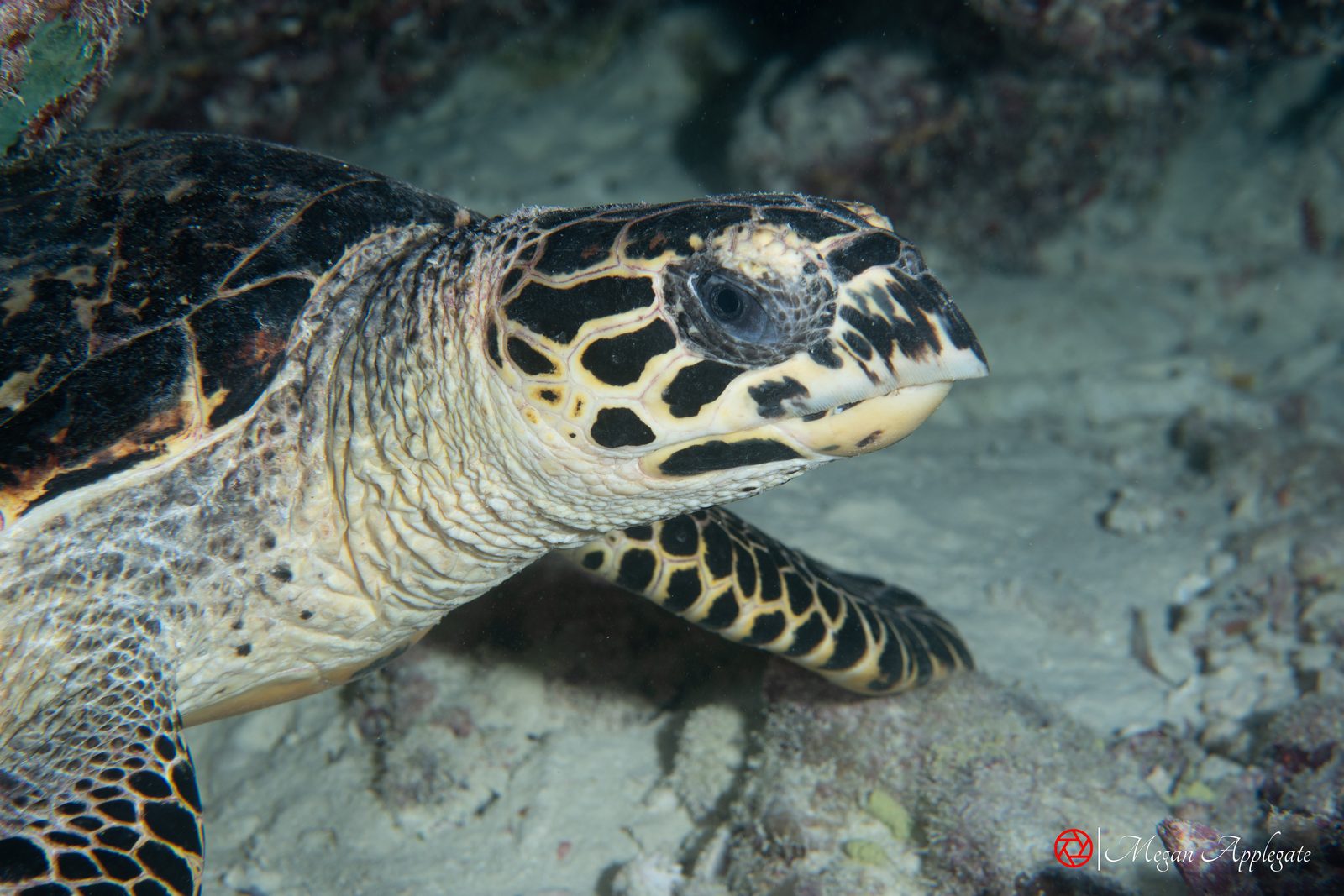
Green, hawksbill and loggerhead turtles all nest on Bonaire and Klein Bonaire (bonaire.com). Hawksbills and greens are on the reefs all year; young greens and hawksbills also feed offshore (WIDECAST / STCB). Leatherbacks are rare: one source says they don’t occur (bonaire.com), while Sea Turtle Conservation Bonaire calls them an occasional visitor (WIDECAST / STCB).
Adults are typically about 1 m long and weigh about 80 kg, and sponges make up 70–95% of their diet. Critically Endangered on the IUCN Red List (Wikipedia).
Key marks: A pointed, beak-like head and thick, overlapping shell plates that give the back edge of the shell a saw-toothed look (bonaire.com; Wikipedia).
At Bonaire: Present all year; nests mainly on Klein Bonaire (bonaire.com).
Adults reach about 1.5 m and eat mainly seagrass (Wikipedia). In October 2025 the IUCN moved the global population from Endangered to Least Concern, though some regional populations are still at risk (Oceanic Society 2025).
Key marks: Smooth shell edges with plates that don’t overlap, and a short, rounded head (bonaire.com; Wikipedia).
At Bonaire: Present all year and feeds on the seagrass of Lac Bay; nests mainly at Playa Chikitu in Washington Slagbaai National Park (bonaire.com).
Key marks: A massive, broad head, a shell often covered in barnacles, and fairly short front flippers (bonaire.com).
At Bonaire: Seen almost only in the nesting season; nests mainly on Klein Bonaire (bonaire.com). The first nest of 2026, probably a loggerhead’s, was found on Klein Bonaire on 28 April (InfoBonaire 2026).
Table — Bonaire’s three nesting turtles compared, from bonaire.com, with the 2025 IUCN status of the green turtle from the Oceanic Society.
Hawksbill
Green
Loggerhead
Head
Pointed, beak-like
Short and rounded
Massive and broad
Shell plates
Overlapping; saw-toothed back edge
Not overlapping; smooth edge
Often covered in barnacles
When seen
All year
All year
Mostly the nesting season
Main nesting area
Klein Bonaire
Playa Chikitu (Washington Slagbaai)
Klein Bonaire
IUCN Red List
Critically Endangered
Least Concern (since 2025)
Vulnerable
Nesting
The nesting season
May to October, hatching into January
Turtles nest from May to October, and hatchlings emerge until December or January (bonaire.com). A typical season has about 100 nests (InfoBonaire 2026). The 2025 season set a record: 149 nests (77 on Klein Bonaire, 41 in Washington Slagbaai and 31 on the southern beaches) and 11,641 hatchlings, the most since counts began in 2002 (BES Reporter 2026).
Table — Nests by species, from Statistics Netherlands (CBS) (CBS 2025). The 2024 row is the table’s figures; the article text gives 150 nests for 2024.
Year
Loggerhead
Hawksbill
Green
Total
2023
35
59
35
129
2024
40
66
24
130
Sea Turtle Conservation Bonaire (STCB) patrols the beaches each season (InfoBonaire 2026), relocates threatened nests and tags turtles (BES Reporter 2026). Its satellite tracking began in 2000 (bonaire.com), and tracked turtles have travelled west to feeding grounds off Nicaragua and Honduras and north to Puerto Rico and the Navidad Bank (WIDECAST / STCB).
Protection
Turtles and the law
Fully protected since 1991
In 1991 Bonaire’s Island Council amended the Marine Environment Ordinance to protect all sea turtles fully (WIDECAST / STCB).
On a nesting beach
From May to October, keep lights off the beach at night, don’t drive or dig on the sand, and report nests or tracks to Sea Turtle Conservation Bonaire.