Corals

Bonaire corals

Elkhorn, staghorn, brain and star corals on one of the Caribbean’s healthiest reefs, the disease that reached it in 2022, the nurseries growing corals back, and the nights the corals spawn.

Background photo: Megan Applegate (Bonaire)

The reef

A fringing reef a few metres from shore

About 45 hard corals

Bonaire has about 45 species of hard coral (STINAPA SCTLD action plan), and about 60 corals counting soft corals (Wikipedia (Marine Park)). A survey in July 2010 found about 50% live coral cover at 5–15 m and called Bonaire’s reefs among the healthiest in the western Atlantic (Living Oceans Foundation 2010).

Reef-safe sunscreen

Bonaire banned sunscreens containing oxybenzone or octinoxate from 1 January 2021 (InfoBonaire), and park rules ask divers to use reef-safe sunscreen (STINAPA).

Corals to know

Corals to know

Branching, brain, star and fan

Grooved brain coral Diploria labyrinthiformis

Key marks: A brain coral with a groove running along the top of every ridge. The symmetrical brain coral has smooth, narrow ridges; the boulder brain coral, the largest and most common, has fine grooves down the sides of its ridges (Scuba Diver Life).

Lobed star coral Orbicella annularis

Key marks: Thick columns with domed tops. Its relatives form mountain-like peaks and ridges (mountainous star coral) or irregular plates in deeper water; the great star coral has large, puffy polyps (Scuba Diver Life).

Fire coral stings

Fire coral (Millepora) is a hydrozoan, not a true coral: smooth, mustard to golden-brown with white tips, in branches, blades or boxes, and it also overgrows sea fans. It stings; if you are stung, rinse with seawater, not fresh water (Grand Bay Punta Cana).

Coral disease

Stony coral tissue loss disease

On Bonaire since 2022

On 22 July 2022 a STINAPA biologist found suspected stony coral tissue loss disease (SCTLD) on a pillar coral at Karpata. STINAPA’s action plan notes it was never formally confirmed and could have been an aggressive white plague (STINAPA SCTLD action plan); local news reported it as confirmed (InfoBonaire 2022). Karpata and La Dania’s Leap were closed (InfoBonaire 2022), and from 1 May 2023 all sites north of Karpata to Malmok, including Washington Slagbaai National Park, were closed (InfoBonaire 2023).

Help stop the spread

Rinse or soak your gear in disinfectant between sites, dive the northern sites last in the day, and report diseased coral to STINAPA (InfoBonaire 2022; STINAPA SCTLD action plan). Sites can be closed at short notice, so check which are open before you go (Wikipedia (Marine Park)).

Restoration

Growing corals back

Reef Renewal Foundation Bonaire

The Reef Renewal Foundation Bonaire has worked since 2012 (Reef Renewal Foundation Bonaire). It grows coral fragments on “trees” in underwater nurseries and also raises corals from spawning (Reef Renewal Foundation Bonaire). It reports 12 nurseries, more than 15,000 corals growing in them, 16 species propagated and 70,000 corals planted back on the reef (Reef Renewal Foundation Bonaire).

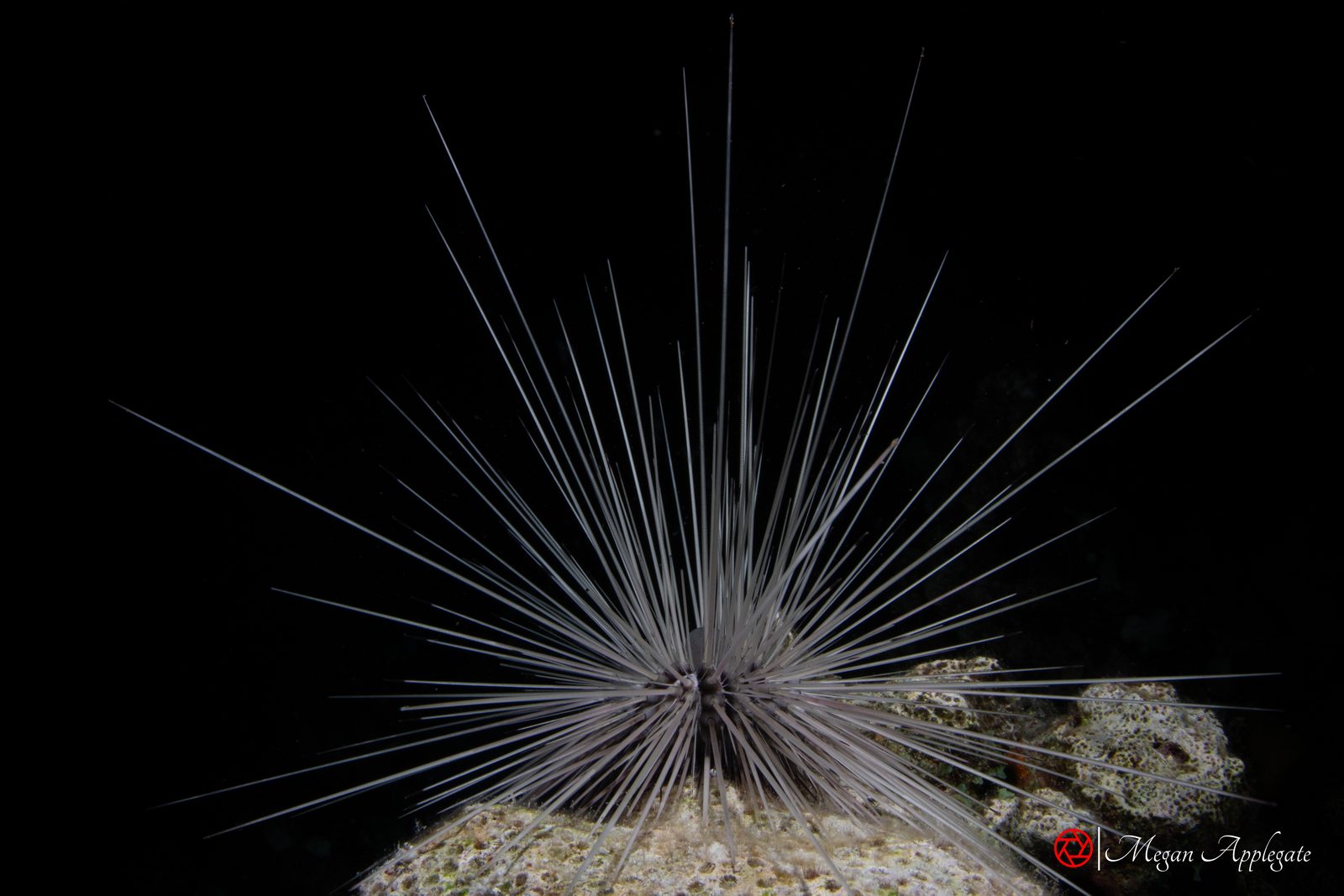
Long-spined sea urchin (Diadema antillarum)
Long-spined sea urchin. Photo © Megan Applegate, Bonaire, December 2024.

Long-spined sea urchin Diadema antillarum

A night-time grazer that keeps algae off the reef (Wikipedia). In 1983 more than 97% of these urchins across the Caribbean died of an unknown disease (Wikipedia), and a second mass die-off, caused by a single-celled parasite, began in January 2022 (USGS 2023).

Key marks: Black spines usually 10–12 cm long, up to 30 cm on large urchins (Wikipedia).

At Bonaire: In July 2022 the new die-off had reached St Eustatius, St Maarten, Saba and Curaçao but had not been reported on Bonaire (InfoBonaire 2022). The Reef Renewal Foundation monitors young urchins settling at six leeward sites (Reef Renewal Foundation Bonaire). Photographed on a Bonaire night dive in December 2024.

Spawning

Coral spawning

Late summer nights after the full moon

Most of Bonaire’s reef-building corals spawn on a few nights after the full moons of late July to early October; elkhorn spawns around 21:00–22:15, staghorn around 21:20–22:35 and pillar coral around 20:25–21:25 (RRFB 2026 spawning calendar). The Reef Renewal Foundation publishes the predictions as a calendar.

Table — Coral spawning on Bonaire in 2026, from the Reef Renewal Foundation calendar (RRFB 2026 spawning calendar). Dates change every year with the moon.
Coral or windowDatesTime
Grooved brain coralApril–June, 9–13 nights after full moon17:30–19:00
Main window 129 July – 7 August 2026about 19:00–23:15
Main window 227 August – 5 September 2026about 19:00–23:15
Main window 326 September – 5 October 2026about 19:00–23:15