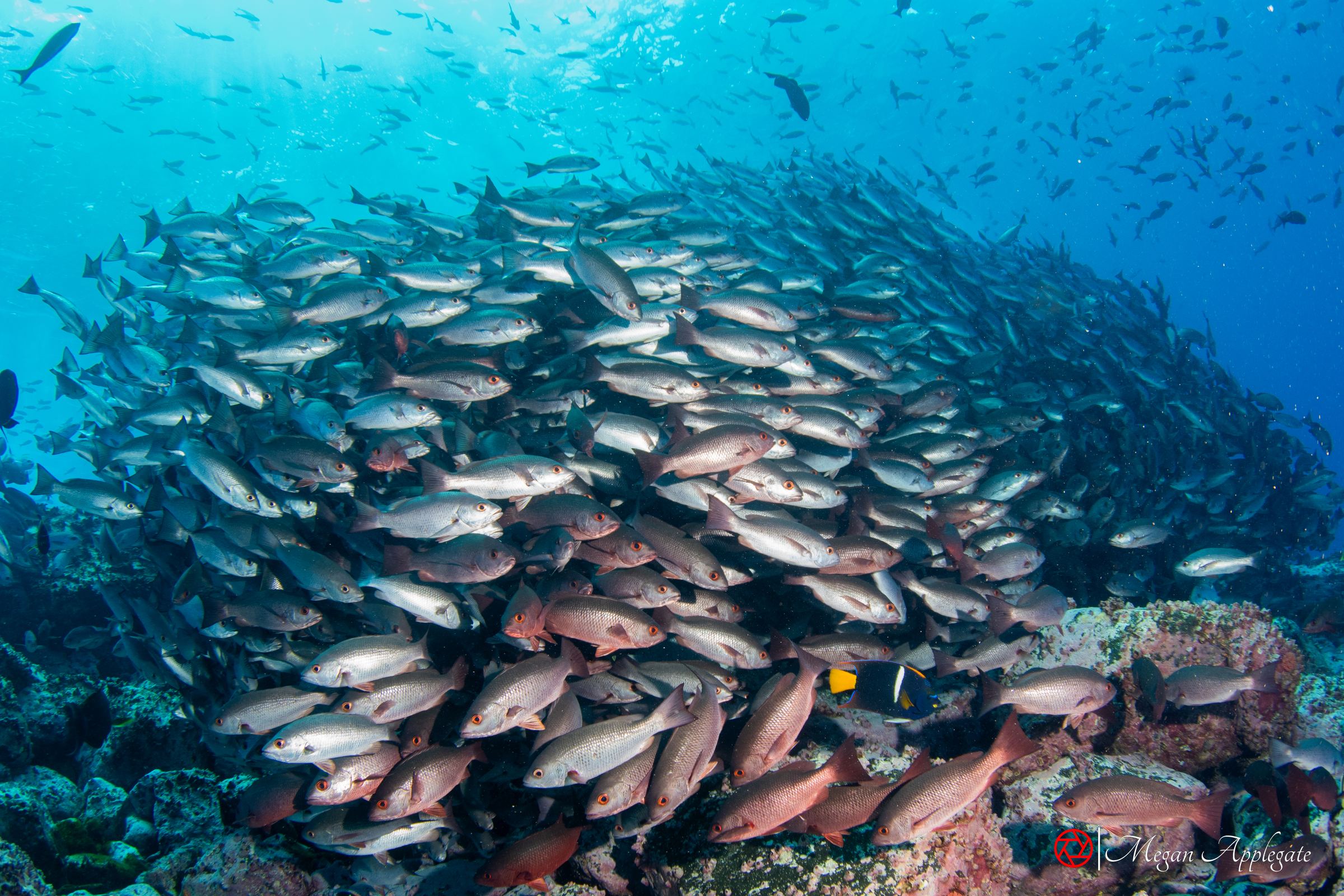
A dense school of fish over the reef at Malpelo

Resources

Keep learning between dives.

Where to learn the fish before a trip, identify what you photographed, and check that a name is still current. Each entry says what it is good for and which guides it goes with.

Reef school, Malpelo · photo Megan Applegate

What do you need?

Show resources for

Learn the fish before you go

Classes, quizzes and a starter app, so the common species are familiar by the first dive.

Online classesWorldwide

REEF Fishinars ↗ (opens in a new tab)

  • Good for:
  • Fish families
  • Invertebrates
  • ID by region
  • Quizzes

Free hour-long online ID classes from REEF, the Reef Environmental Education Foundation. The archive is organized by region, including the Tropical Western Atlantic (Caribbean), the Tropical Eastern Pacific and the South Pacific / Central Indo-Pacific, and runs from blennies, gobies, groupers, wrasses and parrotfish to invertebrates, sharks and mantas. Most sessions have a printable cheat sheet. REEF also posts quizzes on common fish and invertebrates and Quizlet study decks.

Live sessions are free and open to anyone. Recordings and cheat sheets need a REEF membership, which is also free.

Visit ↗ (opens in a new tab) Fishinar archive ↗ (opens in a new tab) Join REEF (free) ↗ (opens in a new tab)

AppCaribbean

Easy Fish ID Caribbean ↗ (opens in a new tab)

  • Good for:
  • Learning the common fish
  • Quiz mode
  • Find by color or shape

A “Fish ID 101” app by John P. Hoover: 280 common fish of the Caribbean, Florida, the Bahamas and Bermuda in 845 photos, with juveniles, males and females where they differ, plus turtles. Narrow a fish down by color, shape, family or name; the quiz mode drills you and the logbook keeps what you saw. A good warm-up before Bonaire. For full coverage the author points to Humann and DeLoach’s Reef Fish Identification (below).

iPhone and iPad · US$9.99 on the App Store · no ads or in-app purchases.

Visit ↗ (opens in a new tab) Source for these details ↗ (opens in a new tab)

Identify a fish you saw

Apps, websites and books for working out what was in the photo, by region.

App and websiteCaribbean

Bonaire Fish ID ↗ (opens in a new tab)

  • Good for:
  • Bonaire fish
  • Corals and creatures
  • How common, how deep

A free, non-commercial project from Bonaire: about 800 species of fish, corals and other reef life photographed around the island, in more than 3,000 photos. Each entry gives the distinctive features, how often it is seen and its usual depth range, so it doubles as a checklist of what to expect.

Free · website plus iPhone, iPad and Android apps · photos shared under CC BY-NC 4.0.

Visit ↗ (opens in a new tab) App Store ↗ (opens in a new tab) Google Play ↗ (opens in a new tab) Source for these details ↗ (opens in a new tab)

WebsiteCaribbean

Shorefishes of the Greater Caribbean ↗ (opens in a new tab)

  • Good for:
  • Narrowing down a fish
  • Lookalikes side by side
  • Species list for a site
  • Range maps

The Smithsonian Tropical Research Institute’s reference to Caribbean shore fishes, by D. R. Robertson and J. Van Tassell. “Find a Fish” narrows down an ID, “Compare” puts 2 to 6 species side by side, and the Species List Assembly lists what has been recorded at one or two sites. In English and Spanish, with iPhone and Android apps.

Website in English and Spanish · Smithsonian Tropical Research Institute.

Visit ↗ (opens in a new tab)

WebsiteEastern Pacific

Shorefishes of the Eastern Pacific ↗ (opens in a new tab)

  • Good for:
  • Narrowing down a fish
  • Lookalikes side by side
  • Island species lists

The same Smithsonian system for the eastern Pacific, by D. R. Robertson and G. R. Allen. Its region takes in the offshore islands, Revillagigedo (Socorro), Clipperton, Cocos, Malpelo and the Galápagos, so it is the closest thing to a complete fish list for those guides. Same tools: Find a Fish, side-by-side comparison, common-name search and species lists for one or two sites.

Website in English and Spanish · Smithsonian Tropical Research Institute.

Visit ↗ (opens in a new tab) Source for these details ↗ (opens in a new tab)

BooksCaribbeanEastern PacificIndo-Pacific

Reef Fish Identification (Humann & DeLoach) ↗ (opens in a new tab)

  • Good for:
  • ID on the boat
  • Lookalikes and color phases

The dive-boat standard from New World Publications, by Paul Humann and Ned DeLoach, arranged by family with the marks that separate lookalikes. Regional editions: Florida · Caribbean · Bahamas (4th edition, 2014, 683 species), Tropical Pacific (about 2,000 species, with Gerry Allen, Roger Steene and John Jackson), Baja to Panama, and Galápagos (2nd edition).

Printed books · New World Publications.

Visit ↗ (opens in a new tab)

App and websiteWorldwide

iNaturalist ↗ (opens in a new tab)

  • Good for:
  • Getting a photo identified
  • Logging what you saw

Post a photo and iNaturalist suggests what it might be; other naturalists, specialists among them, then confirm or correct the ID. Useful for the odd invertebrate or juvenile that the books skip, and every observation becomes data for researchers. Run by an independent nonprofit. Its sister app Seek gives an ID from the camera without posting anything.

Free · website, iPhone and Android.

Visit ↗ (opens in a new tab) Source for these details ↗ (opens in a new tab)

Nudibranchs, creatures and corals

For everything that isn’t a fish.

BooksCaribbeanIndo-Pacific

Reef Creature & Reef Coral Identification ↗ (opens in a new tab)

  • Good for:
  • Invertebrates
  • Caribbean corals

The companions to the Humann and DeLoach fish books. Reef Creature Identification covers invertebrates: Florida · Caribbean · Bahamas (3rd edition, 2013, 900 species, with Les Wilk) and Tropical Pacific (2010). Reef Coral Identification: Florida · Caribbean · Bahamas (3rd edition, 2013). With the fish book they make the three-book “Reef Set” for Bonaire.

Printed books · New World Publications.

Visit ↗ (opens in a new tab)

WebsiteWorldwide

Corals of the World ↗ (opens in a new tab)

  • Good for:
  • Reef-building corals
  • Range maps

Charlie Veron and colleagues’ reference to reef-building corals: species factsheets, a taxon finder, ecoregion factsheets and an interactive distribution map. Still labeled beta, and the authors say where they disagree with recent name changes.

Free website.

Visit ↗ (opens in a new tab)

Check the current scientific name

Names change as taxonomists revise groups. When a book and an app disagree, these settle it.

DatabaseWorldwide

Eschmeyer’s Catalog of Fishes ↗ (opens in a new tab)

  • Good for:
  • Is this fish name still valid?
  • Old names and synonyms

The California Academy of Sciences’ catalogue of every fish genus and species name, the reference ichthyologists use to tell the valid name from its synonyms. A new version comes out monthly. Check here when a book and an app give a fish different scientific names.

Free database · California Academy of Sciences.

Visit ↗ (opens in a new tab)

DatabaseWorldwide

WoRMS: World Register of Marine Species ↗ (opens in a new tab)

  • Good for:
  • Nudibranch, coral and shrimp names
  • Synonyms
  • Checking a whole list

Everything in the sea, not just fish: about 251,000 accepted marine species and the synonyms that point to them, kept current by some 370 taxonomic editors and hosted by the Flanders Marine Institute (VLIZ). Its “Match Taxa” tool checks a whole species list against the current names.

Free database.

Visit ↗ (opens in a new tab)

What lives at a site, and how common it is

Survey data from other divers, and how to add your own.

DatabaseWorldwide

REEF survey data reports ↗ (opens in a new tab)

  • Good for:
  • What has been seen at a site
  • Comparing sites
  • Where a species turns up

Volunteer REEF surveys going back to 1990, searchable. The Geographic Area Report lists the species recorded in a region or at a dive site, the Comparison Report sets up to three areas side by side, and the Distribution Report shows where a species or family has been sighted.

Free · reef.org.

Visit ↗ (opens in a new tab) Source for these details ↗ (opens in a new tab)

Citizen scienceWorldwide

REEF Volunteer Fish Survey ↗ (opens in a new tab)

  • Good for:
  • Practicing your ID
  • Adding to the data

Turn fish watching into data. On a REEF survey you swim the site freely, note every species you can positively identify, then give each an abundance band: 1, 2 to 10, 11 to 100, or more than 100. The results go into the public database above, used by resource agencies and researchers.

Free for REEF members (membership is free).

Visit ↗ (opens in a new tab) Source for these details ↗ (opens in a new tab)

Birds from the boat

Boobies, frigatebirds and terns between dives.

AppWorldwide

Merlin Bird ID ↗ (opens in a new tab)

  • Good for:
  • Bird ID from a photo or song
  • Works offline

The Cornell Lab of Ornithology’s app identifies a bird from a photo, a recording of its call, or a few questions about size, color and behavior. Download the bird pack for your destination before the trip and it works with no signal at sea.

Free · iPhone and Android.

Visit ↗ (opens in a new tab)

Website and appWorldwide

eBird ↗ (opens in a new tab)

  • Good for:
  • Recent sightings
  • Logging your birds

The Cornell Lab’s worldwide bird checklist database. Look up recent sightings and hotspots for a destination, or log the boobies and frigatebirds you saw from the boat.

Free · website and app.

Visit ↗ (opens in a new tab)

Details checked on 15 October 2026. Prices and features change; the linked pages have the latest.