From the boat
Seabirds and shore birds
Over the lagoon, on the islets and the reef flats
More than 100 bird species are on the Chuuk checklist, most of them seabirds and migrant shorebirds (Avibase). These are the ones most likely to be seen between dives. Pacific golden plovers and ruddy turnstones turn up on the hotel lawns of Weno, and wandering tattlers on the shores of Dublon (Birdquest 2024).
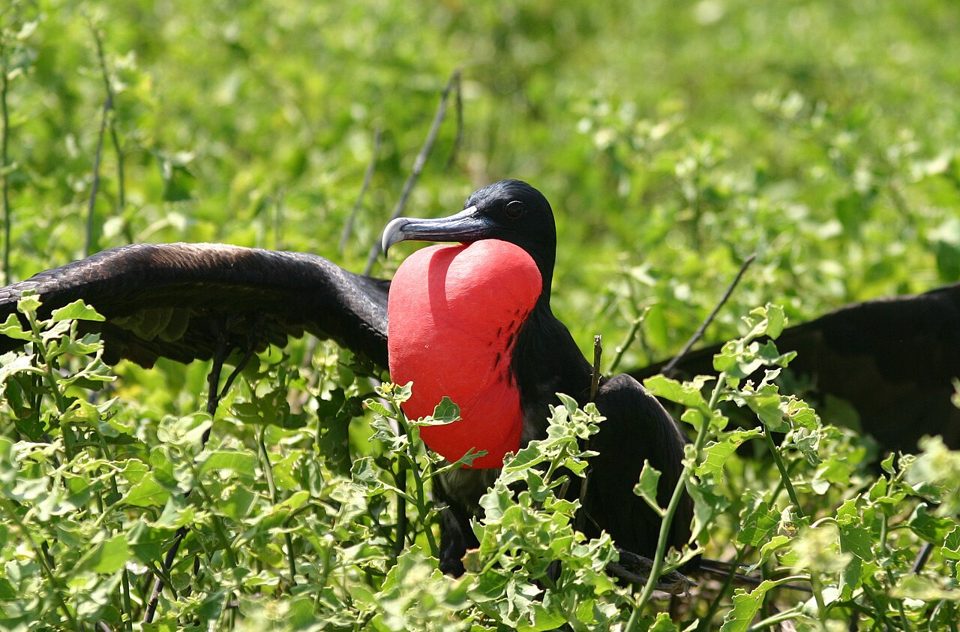
Great frigatebird Fregata minor
Key marks: Very long, angular wings held in a kinked M and a long, deeply forked tail. Adult males are all black with a red throat pouch; females have a pale throat.
At Chuuk: On the Chuuk bird checklist (Avibase).
Brown booby Sula leucogaster
Key marks: Dark chocolate-brown head, breast and upperparts, sharply divided from a white belly; yellowish bill and feet.
At Chuuk: On the Chuuk bird checklist (Avibase).
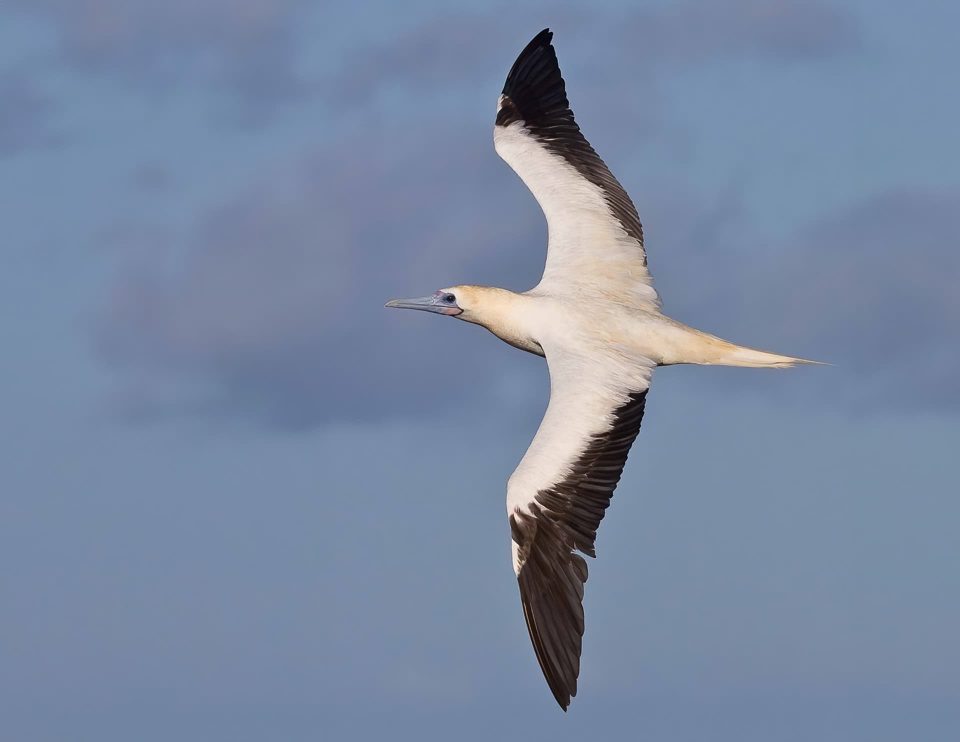
Red-footed booby Sula sula
Key marks: The smallest booby, and the only one with bright red feet at any age. It comes in several colour forms: all brown, white, and white with a black tail.
At Chuuk: On the Chuuk bird checklist (Avibase).
White-tailed tropicbird Phaethon lepturus
Key marks: White, with a black band on the inner wing, a black eye mask, an orange-yellow to orange-red bill and, in adults, very long white tail streamers. Unlike the red-billed tropicbird, its back is pure white (Wikipedia).
At Chuuk: On the Chuuk bird checklist (Avibase).
Pacific reef heron Egretta sacra
Key marks: A medium heron, 57–66 cm, in two colour forms: charcoal grey with a narrow white throat stripe (the more common) and all white. Brown bill, yellow-grey legs. It hunts in shallow water by day and night (Wikipedia).
At Chuuk: On the Chuuk bird checklist (Avibase).
Found nowhere else
Land birds of the high islands
Ashore on Weno, Dublon and Tol
Chuuk is part of the East Caroline Islands Endemic Bird Area, and its native forest survives only in small patches on the higher reaches of a few islands (BirdLife). Three birds live only in Chuuk (Avibase): the Chuuk monarch, the Chuuk flycatcher and the teardrop white-eye, which is found only on one mountaintop on Tol (Wikipedia). No photos yet on this page; each card links to photos online.
Chuuk monarch Metabolus rugensis
Key marks: A large monarch flycatcher, about 20 cm. Males are almost all white with a black face and throat; females are all black. Both have a pale blue bill (Wikipedia).
At Chuuk: Found only in Chuuk; Endangered, because of the loss of its forest (Wikipedia). A birding group had a singing, displaying pair on Dublon in April 2024 (Birdquest 2024).
Teardrop white-eye Rukia ruki
Key marks: A white-eye of 14–15 cm (Oiseaux.net).
At Chuuk: Found only on the summit of Mount Winipot on Tol, in montane rainforest dominated by the endemic Chuuk poisontree; Endangered (Wikipedia). The largest remaining forest in Chuuk, 0.68 km², is on Tol (BirdLife). Reaching it means a hard climb with a local guide (Birdquest 2024).
Chuuk flycatcher Myiagra oceanica
Key marks: A small flycatcher, about 15 cm (Oiseaux.net). Also called the oceanic or Truk flycatcher (Wikipedia).
At Chuuk: Found only in Chuuk (Avibase). Very common on Dublon in April 2024 (Birdquest 2024).
Micronesian myzomela Myzomela rubratra
Key marks: A small honeyeater, about 13 cm. Males are scarlet with black lores; females are duller, black or brown with red patches (Wikipedia).
At Chuuk: Chuuk has its own subspecies, major, which nests all year (Wikipedia). Seen in hotel grounds on Weno (Birdquest 2024).
Caroline Islands white-eye Zosterops semperi
Key marks: Also called the citrine white-eye; Chuuk’s birds are the subspecies owstoni (Birdquest 2024).
At Chuuk: Found in Palau and the Federated States of Micronesia (Wikipedia). Seen on Weno (Birdquest 2024).
Micronesian starling Aplonis opaca
Key marks: About 23 cm; adults are glossy black with a short tail and a yellow eye (Guampedia).
At Chuuk: Found only in Micronesia (Avibase). Seen in hotel grounds on Weno (Birdquest 2024).
Micronesian imperial pigeon Ducula oceanica
Key marks: A big pigeon, about 36 cm: ashy grey head and neck, dark green back and wings, a dark rufous vent and purplish-red feet (Wikipedia).
At Chuuk: Found on Chuuk and other Micronesian islands; Vulnerable, threatened by hunting and forest loss (Wikipedia).
Blue-faced parrotfinch Erythrura trichroa
Key marks: About 13 cm; green, with a deep blue face and forehead and a red to rusty tail. Females have less blue on the face (Wikipedia).
At Chuuk: Good numbers in the grounds of the Blue Lagoon Resort on Weno in 2024 (Birdquest 2024).
Credits
Bird photo credits
Photos and their sources
These photos were taken elsewhere and show what each species looks like.
| Species | Photographer | Licence | Source |
|---|---|---|---|
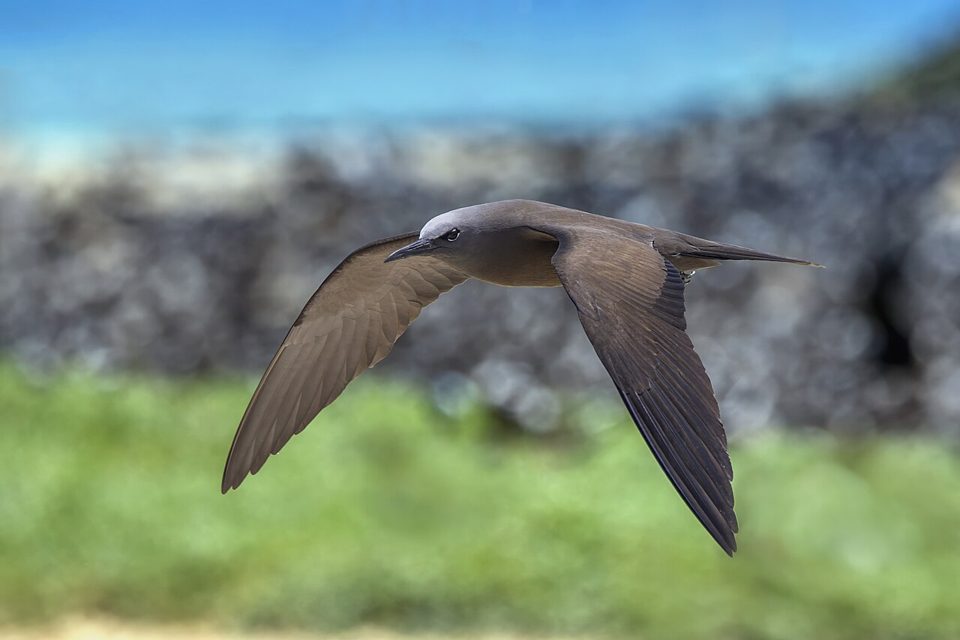
| Brown noddy | Charles J. Sharp | CC BY-SA 4.0 | Wikimedia Commons |
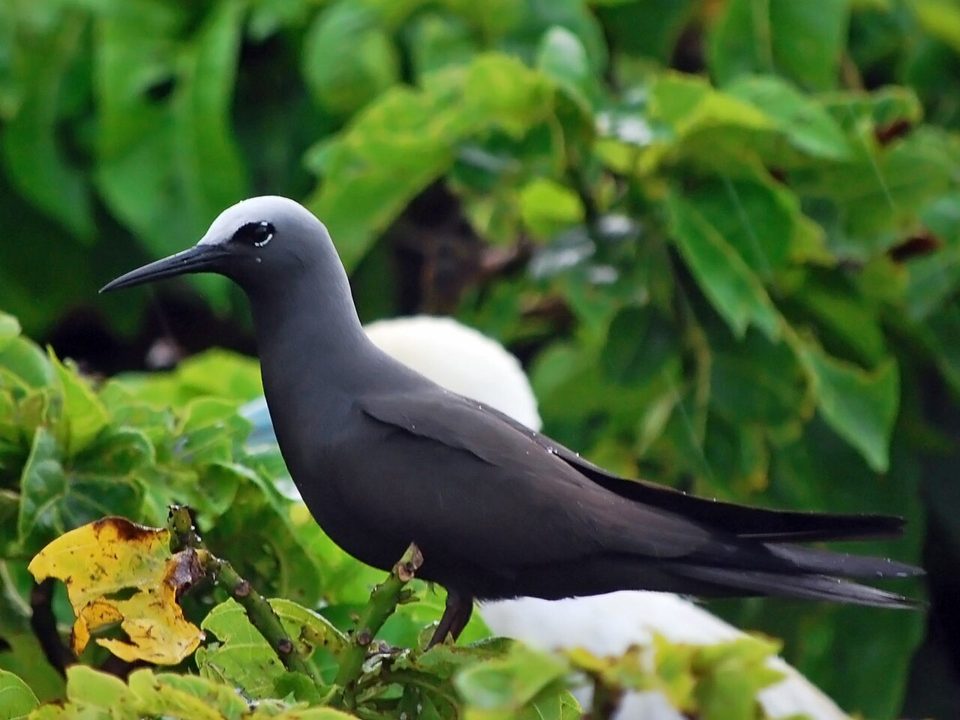
| Black noddy | Gregg Yan | CC BY-SA 3.0 | Wikimedia Commons |
| Great frigatebird | Charles J. Sharp | CC BY-SA 3.0 | Wikimedia Commons |
| Red-footed booby | Pacific Rim Conservation, photographer not named | © Pacific Rim Conservation, no open licence stated | pacificrimconservation.org |