Red-billed tropicbirds, boobies and noddies on Little Tobago, frigatebirds on St Giles, and manakins, motmots and the cocrico in the oldest protected forest of its kind.
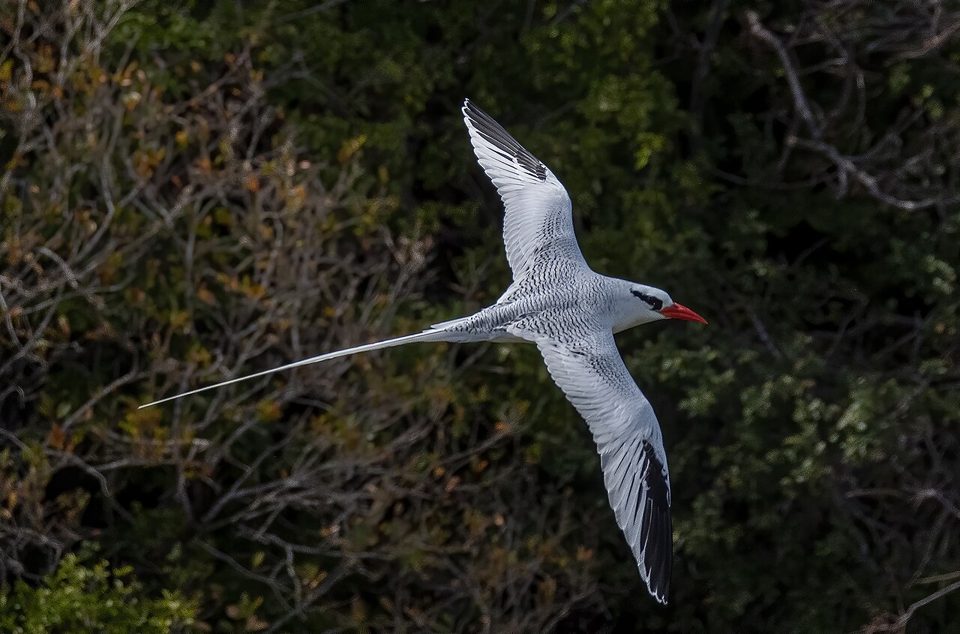
Red-billed tropicbird. Reference photo, not taken at Tobago; see the credits below.
Background photo: Megan Applegate (Tobago)
Seabirds
Little Tobago and St Giles
Seabird islands off the north-east
Trinidad and Tobago together have 489 bird species on the official list (Wikipedia); for Tobago alone, sources give about 200 (Wanderlust) or some 260 (BBC Wildlife).
Little Tobago, about 1 km² and some 2 km off Speyside (Wikipedia (Little Tobago); KBA Little Tobago), was bought by Sir William Ingram in 1908, who brought in birds-of-paradise in 1909; it passed to the government after his death in 1924, and the birds-of-paradise have not been reliably recorded since Hurricane Flora in 1963 (Wikipedia (Little Tobago)). More than 50 bird species have been seen there and about 30 nest (Caribbean Birding Trail); another source says 33 breed (Caribbean Beat). Besides the birds below, Audubon’s shearwater, laughing gull, sooty and bridled terns and a few pairs of white-tailed tropicbirds breed on the island (Wikipedia (Little Tobago)). Up to 80 masked boobies roost on the St Giles Islands (KBA St Giles Islands).
Red-billed tropicbird. Reference photo, not taken at Tobago; see the credits below.
Red-billed tropicbird Phaethon aethereus
Key marks: Mostly white, with a red bill, a black mask, black wing tips and a finely barred back; adults trail tail streamers 46–56 cm long, and measure 90–105 cm with them (Wikipedia).
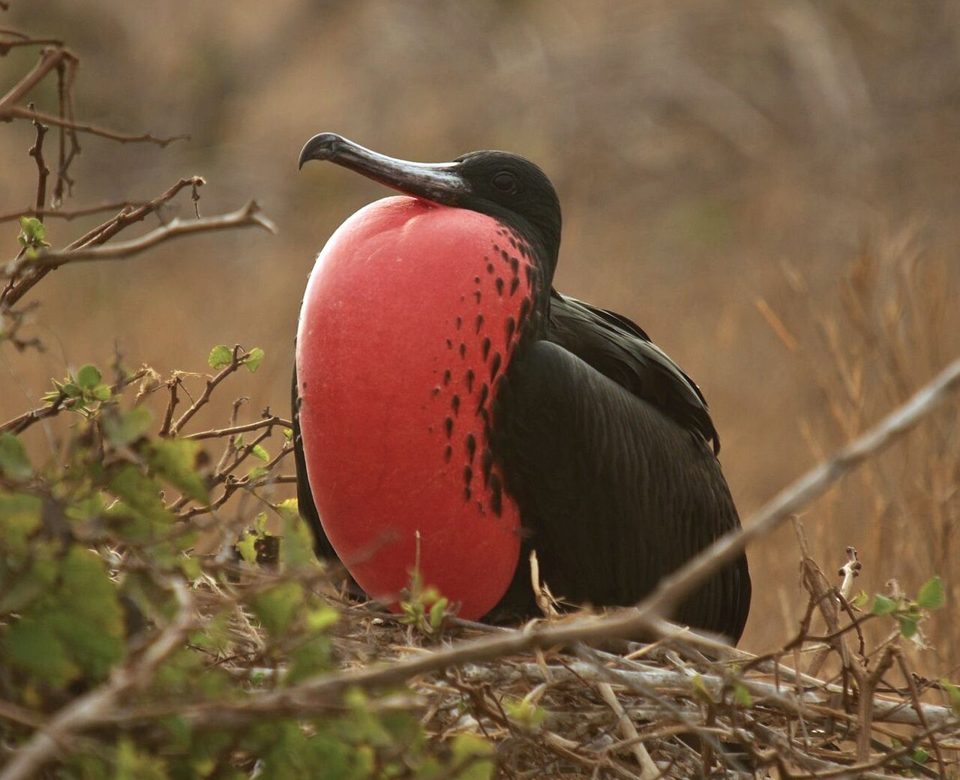
Magnificent frigatebird. Reference photo, not taken at Tobago; see the credits below.
Magnificent frigatebird Fregata magnificens
Key marks: Long, angled wings spanning 2.2–2.4 m and a forked tail. Males are all black with a red throat pouch; females have a white breast; young birds have a white head (Wikipedia).
At Tobago: The St Giles Islands, off the north-east tip, hold the only magnificent frigatebird and red-footed booby breeding colonies in Trinidad and Tobago (KBA St Giles Islands); landing there is prohibited (10,000 Birds).
The tropicbirds are there from December to July (BBC Wildlife). Keep to the trail and give nesting birds room.
Forest
The Main Ridge forest
Between dives, up the hill
The Main Ridge Forest Reserve covers about 3,958 ha (UNESCO tentative list) and rises to 572 m (BBC Wildlife). It is often called the oldest legally protected forest reserve set up for conservation: UNESCO gives its date as 13 April 1776 (UNESCO tentative list), Wikipedia 17 April 1776 (Wikipedia), and the Key Biodiversity Area factsheet says it has been protected since 1765 (KBA Main Ridge). The white-tailed sabrewing, a Near Threatened hummingbird, and the blue-backed manakin were thought wiped out by Hurricane Flora in 1963 (KBA Main Ridge); the sabrewing now numbers more than 1,000 and nests from February to April (BBC Wildlife). On the Gilpin Trace look for the manakin, the yellow-legged thrush, the sabrewing, the rufous-tailed jacamar and the Trinidad motmot (10,000 Birds).
Blue-backed manakin Chiroxiphia pareola
Key marks: About 13 cm. Males are black with a bright blue back and a red crown; females are olive-green. Two males display together on a bare stick, jumping up and down in turn with a buzzing call. Tobago’s own race, atlantica, is larger, with more red on the crown and blue on the back (Wikipedia).
At Tobago: A Tobago speciality of the Gilpin Trace in the Main Ridge Forest Reserve (10,000 Birds).
Key marks: About 46 cm long, green above and deep rufous below, with a turquoise-to-blue crown, a black mask and a long tail ending in two paddle-shaped “racquets” (Wikipedia).
At Tobago: Found only on Trinidad and Tobago, and commoner on Tobago (Wikipedia); seen on the Gilpin Trace (10,000 Birds).
Key marks: A long-tailed, chicken-like bird, 53–58 cm, dark brown above and paler below with a grey head. Pairs duet loudly, mostly at dawn: a low call from the male answered by a high one from the female (Wikipedia).
At Tobago: The cocrico is one of Trinidad and Tobago’s two national birds, on the coat of arms with Trinidad’s scarlet ibis, and Tobago’s only game bird (Government of T&T).
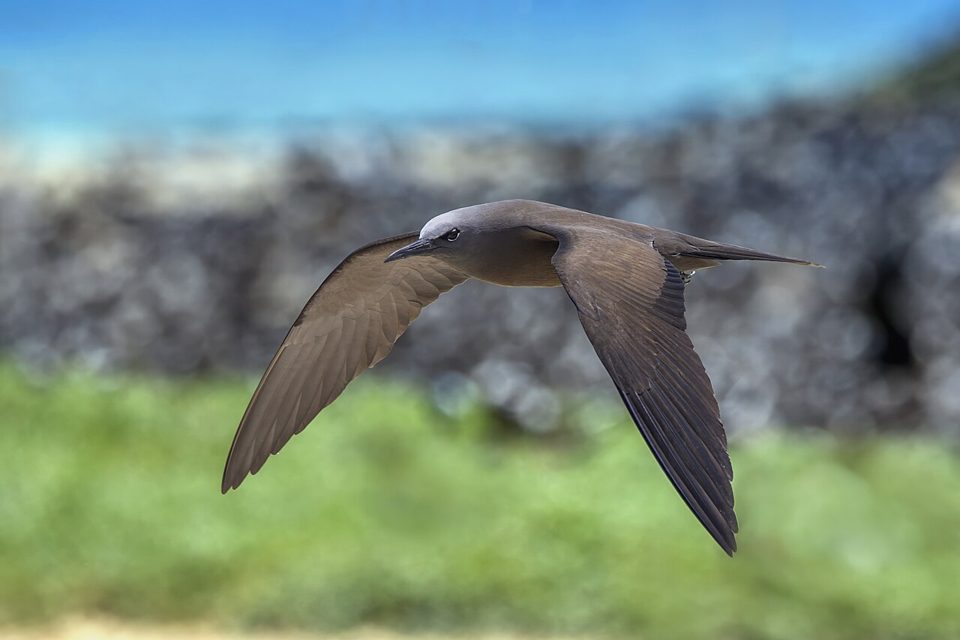
There are no photos of Tobago’s birds in this guide yet. The tropicbird, frigatebird and noddy are reference photos taken elsewhere, credited below; the other birds link to photos online.
Photo credits. Each link opens the page the photo came from.