Brain, star and staghorn corals, the record-sized brain coral off Speyside, the bleaching years, and the nurseries growing corals back.
Background photo: Megan Applegate (Tobago)
The reef
Two kinds of reef
Calm Caribbean side, current-swept Atlantic side
Tobago’s reefs are fed by the Guiana Current, which carries the outflow of the Orinoco (Scuba Diving). The Atlantic-side sites are drift dives, while those on the Caribbean side have almost no current (DAN Alert Diver). Buccoo Reef, in the south-west, has been a marine park since 1973: about 7 km² with five reef flats, down to 25 m, dominated by star corals, finger coral (Porites divaricata) and fire coral (Wikipedia (Buccoo Reef)). Its entrance fees were authorised but, as of 2011, had never been collected (WRI 2011).
Coral cover at Buccoo fell by about 28% between 1994 and 2008, and hard coral cover dropped from 25.19% in 2010 to 16.38% in 2012 (Wikipedia (Buccoo Reef)).
Record
The giant brain coral
Off Speyside, south of Little Tobago
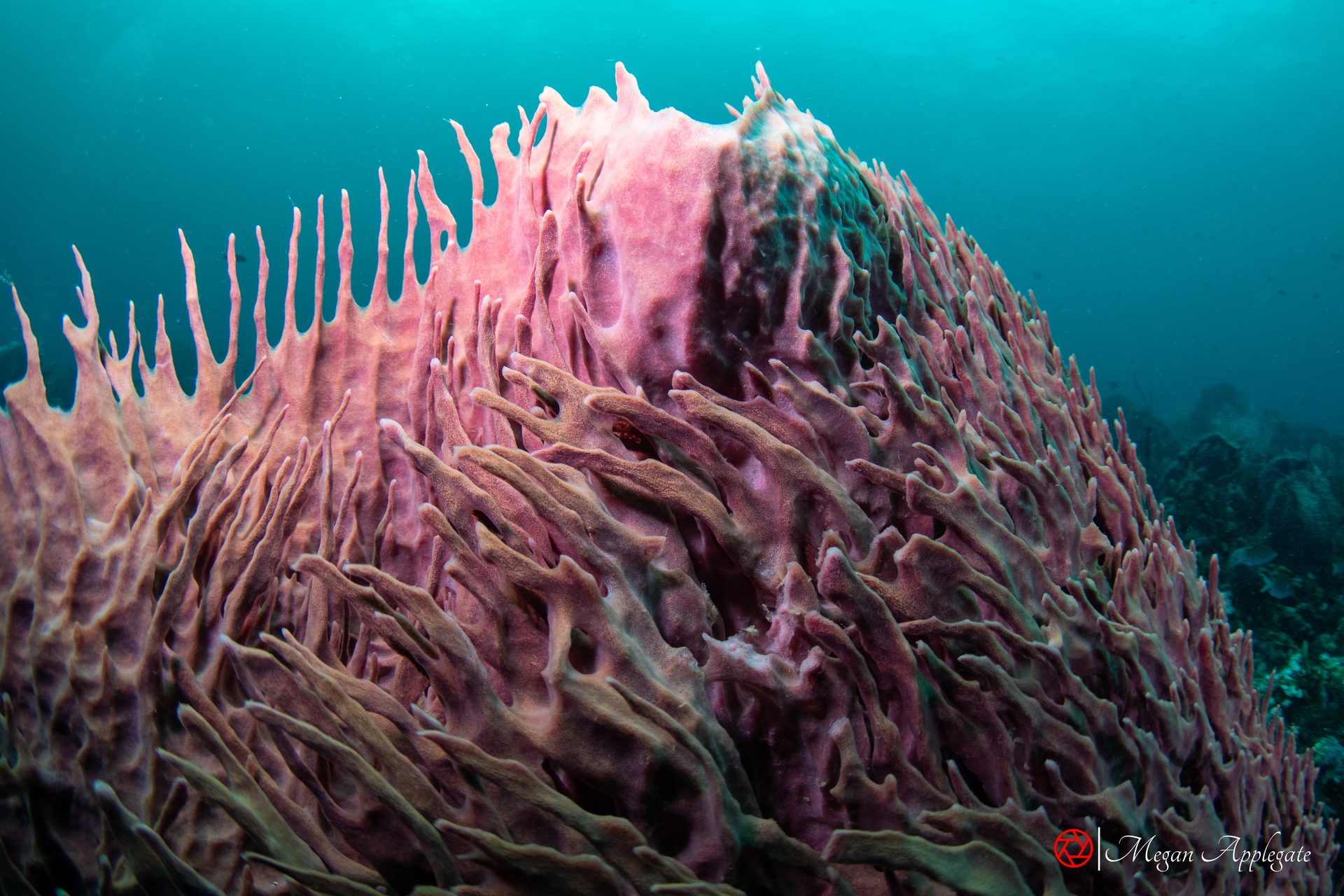
Guinness World Records lists the largest brain coral colony at Kelleston Drain, just south of Little Tobago: about 3 m high and 5 m across (Guinness World Records). Divers’ accounts differ on the details: about 5 m (16.5 ft) across and 3 m (10 ft) high at about 18 m (60 ft) (DAN Alert Diver); about 5 m (16 ft) across at about 17 m (55 ft) and more than 400 years old (Scuba Diving); or, in a 2017 newspaper report, at the western end of the reef slope at about 15 m (50 ft) and roughly 3 m (10 ft) high (Trinidad Express 2017).
No source names its species. A 1998 photo record shows a large Colpophyllia (boulder brain coral) at Blackjack Reef, Speyside (USF Digital Commons (Ogden 1998)). In 2017 the coral showed disease and slight bleaching (Trinidad Express 2017), and in 2024 reports spoke of alarming signs on it (Trinidad Express 2024).
Key marks: A brain coral with a groove running along the top of every ridge. The symmetrical brain coral has smooth, narrow ridges; the boulder brain coral, the largest and most common, has fine grooves down the sides of its ridges (Scuba Diver Life).
At Tobago: Brain corals are among the main reef-builders of Tobago’s reefs, with maze and mountainous star corals (IMA 2025).
Key marks: Thick columns with domed tops. Its relatives form mountain-like peaks and ridges (mountainous star coral) or irregular plates in deeper water; the great star coral has large, puffy polyps (Scuba Diver Life).
At Tobago: After the 2010 bleaching few young lobed star corals settled on Tobago’s reefs (Buglass et al. 2016). Star corals (Montastrea) dominate Buccoo Reef (Wikipedia (Buccoo Reef)).
Key marks: A soft coral spread in a flat, lacy fan 60–180 cm across, at 1–30 m (Florent’s Reef Guide). Flamingo tongue snails feed on gorgonians like it (see the Macro page).
Fire coral (Millepora), one of Buccoo Reef’s dominant corals (Wikipedia (Buccoo Reef)), is a hydrozoan, not a true coral: smooth, mustard to golden-brown with white tips, in branches, blades or boxes, and it also overgrows sea fans. It stings; if you are stung, rinse with seawater, not fresh water (Grand Bay Punta Cana).
Threats
Bleaching, disease and oil
Hot years since 1998
Tobago’s reefs bleached in 1998, 2005 and 2010 (Wikipedia (Buccoo Reef)); the 2005 and 2010 events, followed by disease, killed many of the large coral colonies (Reef Check). In 2010 the sea peaked at 30.5 °C (Alemu & Clement 2014).
Table — Share of corals bleached at the start of the 2010 event, and bleaching mortality, at three sites (Alemu & Clement 2014).
Year
Site
Bleached
Died
2010 (at onset)
Speyside
61.8%
8.3%
2010 (at onset)
Buccoo
38.6%
3.2%
2010 (at onset)
Culloden
31.8%
2.6%
In August 2024 the Institute of Marine Affairs (IMA) warned of significant bleaching at Mount Irvine, Arnos Vale and Charlotteville, with the water above 29 °C (Trinidad Guardian 2024). Reports later in 2024 gave bleaching of up to 78% at some sites after about 24 weeks of heat stress (TTT 2024), and over 80% at Castara, Buccoo, Culloden and Mount Irvine (Trinidad Express 2024).
Stony coral tissue loss disease (SCTLD), which has spread across the Caribbean, had not been officially recorded in Trinidad and Tobago as of 2025; the IMA calls the Speyside giant brain coral highly susceptible (IMA 2025; Cari-Bois 2025).
Report sick coral
Sightings of possible SCTLD can be reported through the SeaiTT app (Cari-Bois 2025).
On 6 February 2024 the barge Gulfstream grounded off Canoe Bay, near Cove, and spilled an estimated 4,652 tonnes of heavy fuel oil; about 15 km of shoreline was oiled, from Cove Reef to Scarborough, and the clean-up ran until 21 April (ITOPF). In July 2025 sargassum seaweed covered the west-coast beaches, from Store Bay to Pigeon Point, within 36 hours (Trinidad Guardian 2025).
Restoration
Growing corals back
Charlotteville and beyond
The Environmental Research Institute Charlotteville (ERIC) opened in 2014 and planted its first nursery-grown staghorn coral in 2018 (Reef Check / ERIC). In 2022 it planted out 230 fragments and built 25 nursery “trees” with room for 1,750 corals, aiming for 5,000 (Woodside / ERIC 2022). In 2023 the IMA announced a coral and seagrass restoration pilot at five Tobago reef sites (Global Fund for Coral Reefs 2023). Environment TOBAGO, a local group founded in 1996, runs ridge-to-reef education (Cari-Bois).
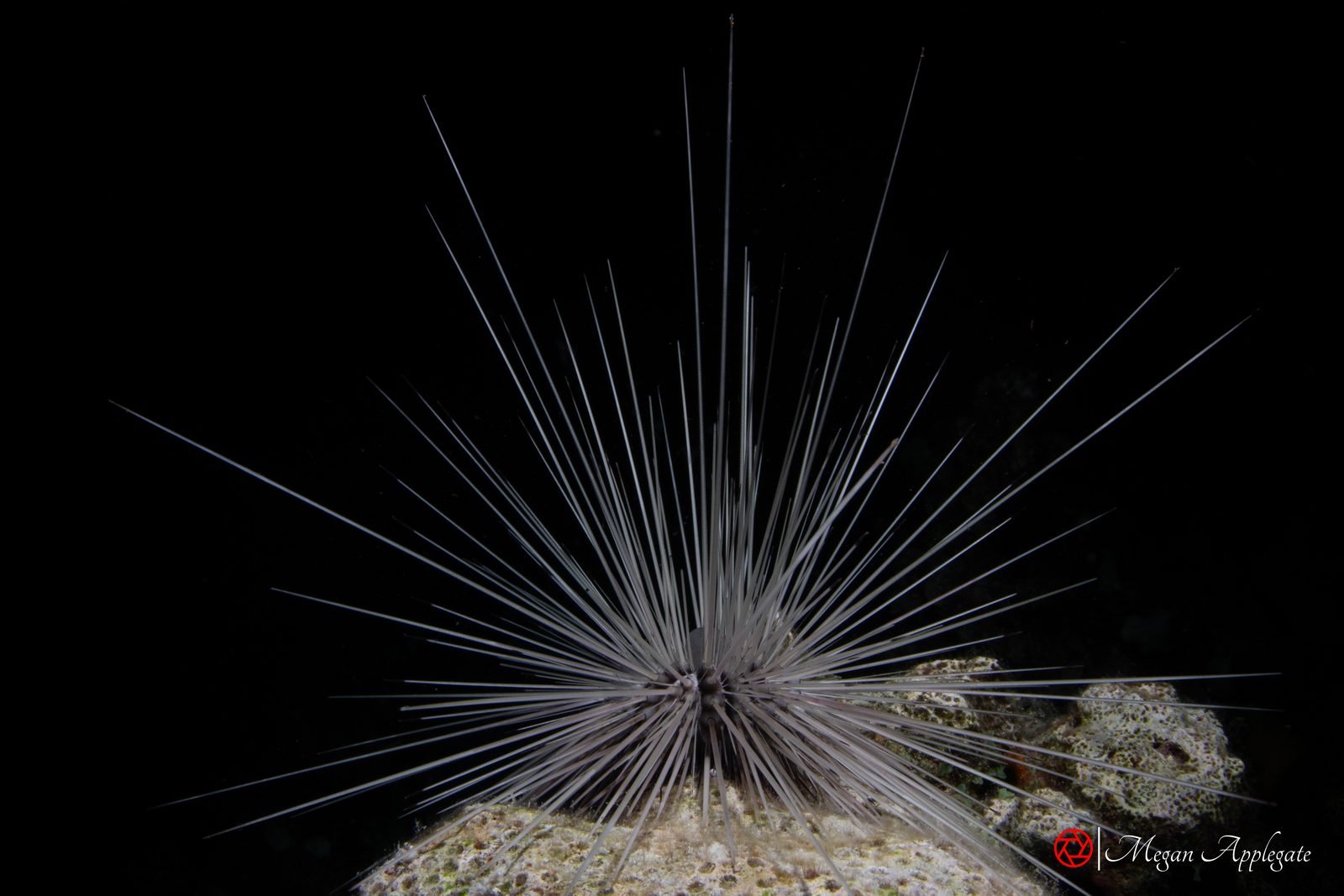
A night-time grazer that keeps algae off the reef (Wikipedia). In 1983 more than 97% of these urchins across the Caribbean died of an unknown disease (Wikipedia), and a second mass die-off, caused by a single-celled parasite, began in January 2022 (USGS 2023).
Key marks: Black spines usually 10–12 cm long, up to 30 cm on large urchins (Wikipedia).