Giant kelp grows up to 60 cm a day from the rock to the surface, and more than 1,000 species live in it. Here is how it works, what is eating it, and how to dive it.
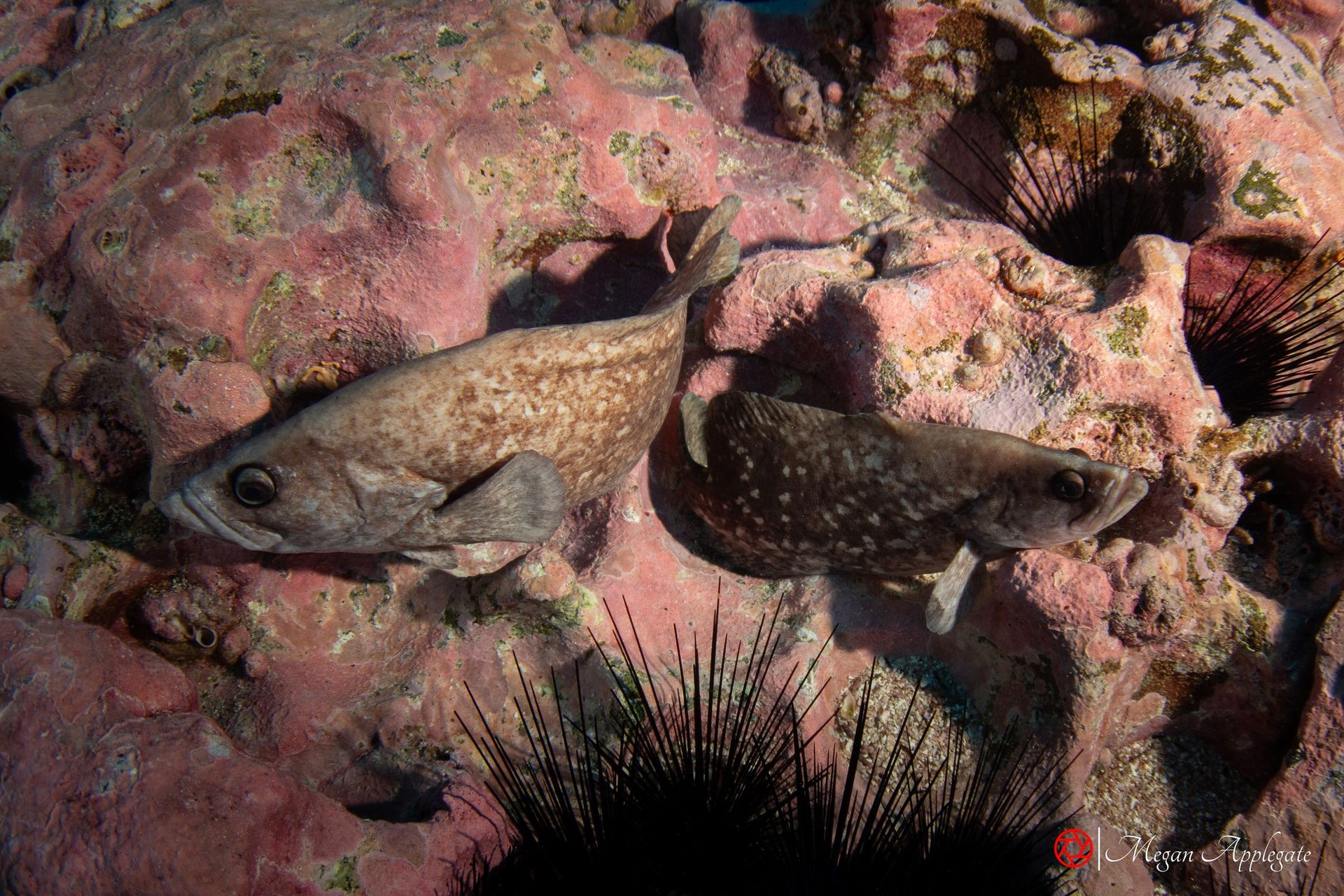
Background photo: Megan Applegate (Malpelo, Colombia, not Southern California)
The kelp
A forest that grows 60 cm a day
Holdfast, stipes, blades and canopy
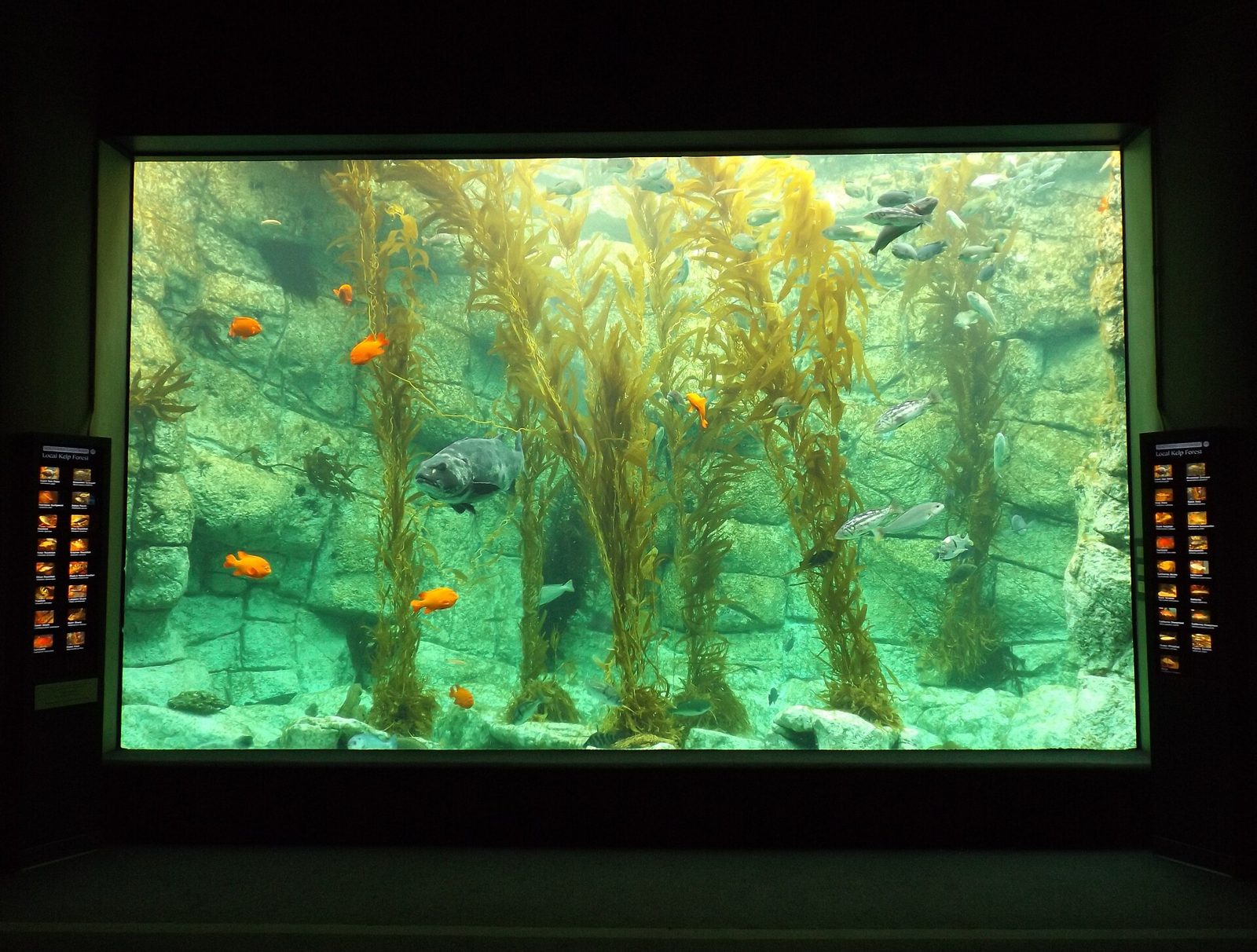
Holdfasts, stalks and blades build a three-dimensional habitat that gives fish and invertebrates food and shelter: more than 1,000 species of plants and animals live in the Channel Islands’ kelp forests, where warm currents from the south mix with cold ones from the north (National Park Service).
Giant kelp. Photo: Tortie tude, CC0, via Wikimedia Commons.
Giant kelp Macrocystis pyrifera
One of the fastest-growing organisms on Earth: up to 60 cm a day (Wikipedia). It is the largest and most prominent kelp in the Channel Islands’ kelp forests (National Park Service).
Key marks: A holdfast anchors it to rock, and stipes rise from it to the surface, with a single gas bladder at the base of each blade to keep it afloat. Plants pass 45 m, and some reach 60 m; a plant can live up to three years, while each frond lasts about 100 days (Wikipedia). It is an alga, not a plant (San Diego Tourism).
In Southern California: About a third of Southern California’s kelp forests lie in Channel Islands National Park and the national marine sanctuary (National Park Service). Off San Diego, the kelp usually grows in 30–80 ft (9–24 m) of water (San Diego Tourism).
The inner edge of a kelp forest is set by how big the breaking waves get, and young kelp settles less as the water gets deeper (Dayton Lab, Scripps). Off San Diego, Point Loma holds one of the largest kelp forests in California, studied by Scripps divers since the early 1950s and monitored since 1971 (Dayton Lab, Scripps).
Urchins
Who keeps the urchins in check
Otters, sheephead, lobsters and sunflower stars
California sheephead, spiny lobsters and sunflower stars eat sea urchins and help keep them in check. Sea otters were once the top urchin predator here, but hunting wiped them out at the islands by about 1900 and they have not come back to Channel Islands National Park; without them urchins can overgraze the kelp and leave “urchin barrens” (National Park Service).
Between 1987 and 1990, 140 sea otters were moved from central California to San Nicolas Island to start a new population. Many swam back north, and in 2011 the colony still numbered only about 50 (US Fish and Wildlife Service 2011).
Then the sunflower star crashed. Sea star wasting disease began in 2013; surveys show a 90.6% drop in sunflower stars, with as many as 5.75 billion animals dead, no sign of recovery five to seven years later, and the species now listed as Critically Endangered. With fewer stars to eat them, purple urchins boomed in many regions (Oregon State University).
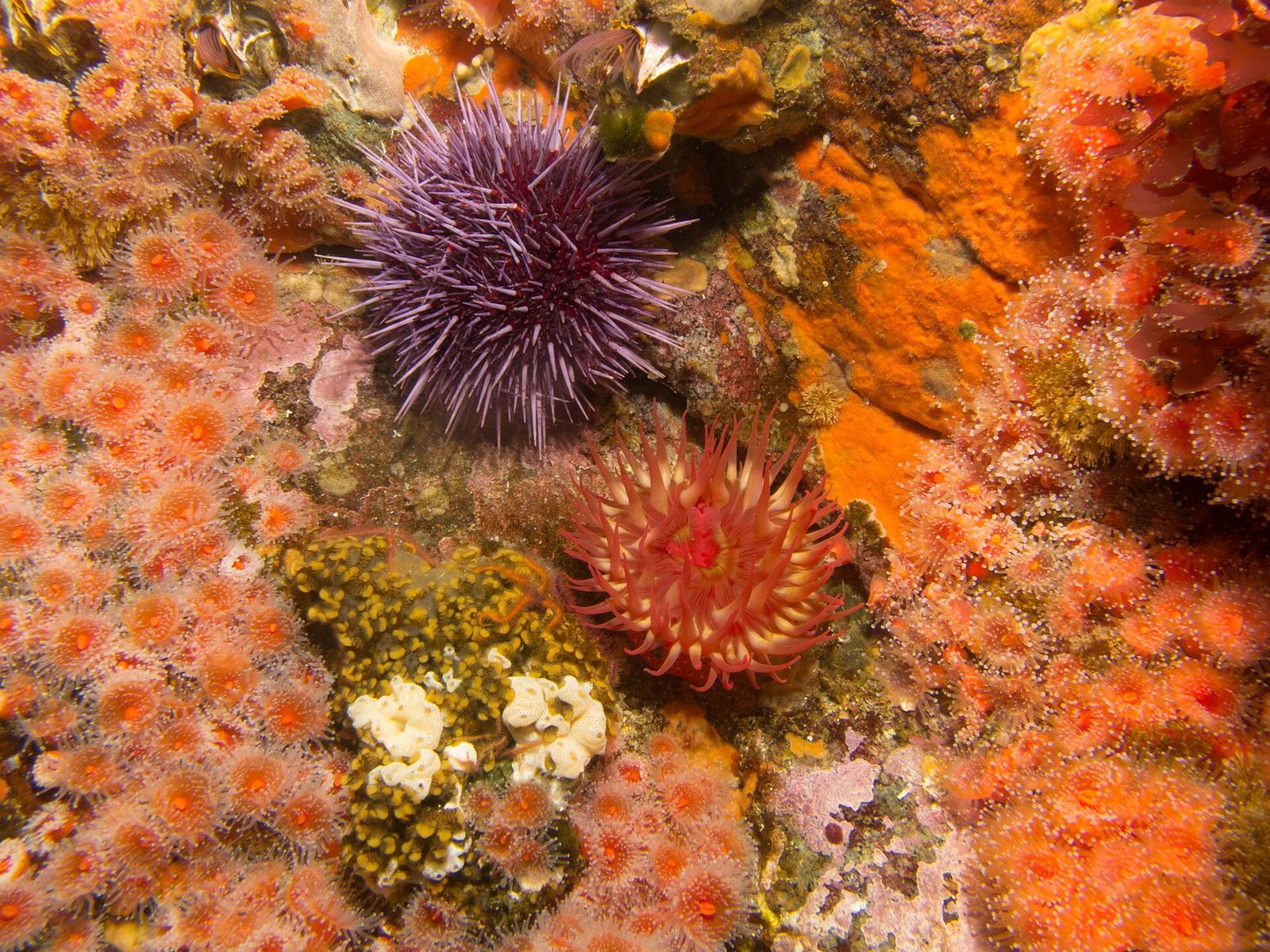
Purple sea urchin. Photo: Ed Bierman from CA, usa, CC BY 2.0, via Wikimedia Commons.
Purple sea urchin Strongylocentrotus purpuratus
Key marks: Deep purple, about 10 cm across. Where it strips the kelp from a reef it leaves an urchin barren. It shares the reef with the larger red urchin, Mesocentrotus franciscanus (Wikipedia).
From 2014 to 2016 a marine heatwave known as “the Blob” sat off California. On five reefs in the Santa Barbara Channel, bottom water ran 3.1 °C above normal in autumn 2015; giant kelp there held up, but the sponges, bryozoans and sea squirts on the rocks fell by 71%, and the reef community, including invasive bryozoans, was still different six years later (Michaud et al. 2022).
Warming water, disease, pollution and overfishing all press on the kelp, and an invasive brown alga, Sargassum horneri, now covers large areas of kelp-forest habitat at the Channel Islands. Marine reserves protect nearly 21% of the national park’s waters (National Park Service).
Off the Palos Verdes Peninsula, The Bay Foundation has brought back more than 80 acres of kelp forest by clearing overabundant purple urchins, working with commercial urchin divers, researchers and volunteers who have logged more than 13,000 hours underwater. Urchin density fell from about 30 to about 2 per square metre, and kelp, invertebrates and fish all increased (The Bay Foundation).
Diving the kelp
How to dive a kelp forest
Cold water, surge and a canopy overhead
Water at the Channel Islands runs about 11–18 °C (52–65 °F) in summer and autumn and 9–16 °C (48–60 °F) in winter and spring: a full 7 mm wetsuit with hood and gloves is needed all year, and a drysuit is the better choice in winter and spring (DAN Alert Diver). At Catalina, a thermocline at about 15 m can drop the temperature by 3–5 °C (DAN Alert Diver).
In the kelp
Swim through the gaps between stalks rather than through the canopy, keep hoses and gauges tucked in so nothing snags, and look up: the light through the canopy is part of the dive. At the end, surface in open water, not under the canopy.
Best kelp dives
La Jolla Cove, a short swim to the inner edge of the kelp inside an ecological reserve (San Diego Tourism); Point Loma (Dayton Lab, Scripps); Casino Point Dive Park in Avalon (Catalina Divers Supply); Anacapa’s landing cove, shown on the park’s live kelp-forest broadcast (National Park Service); and the outer Channel Islands (DAN Alert Diver). See the Overview for the sites.
Credits
Photo credits
Where the photos come from
There are no photos from Southern California by Megan Applegate in this guide yet. Other photos are open-licence photos from Wikimedia Commons, credited in the table with their licence and a link to the original. Species without a photo link to photos on Wikimedia Commons.