Sharks & rays

Solomon Islands sharks & rays

Grey reef sharks in Marovo’s passes, whitetips off Nggatokae, reef mantas at Devil’s Highway, and a blue-spotted stingray described only in 2016, with where and when to look and the marks that tell them apart.

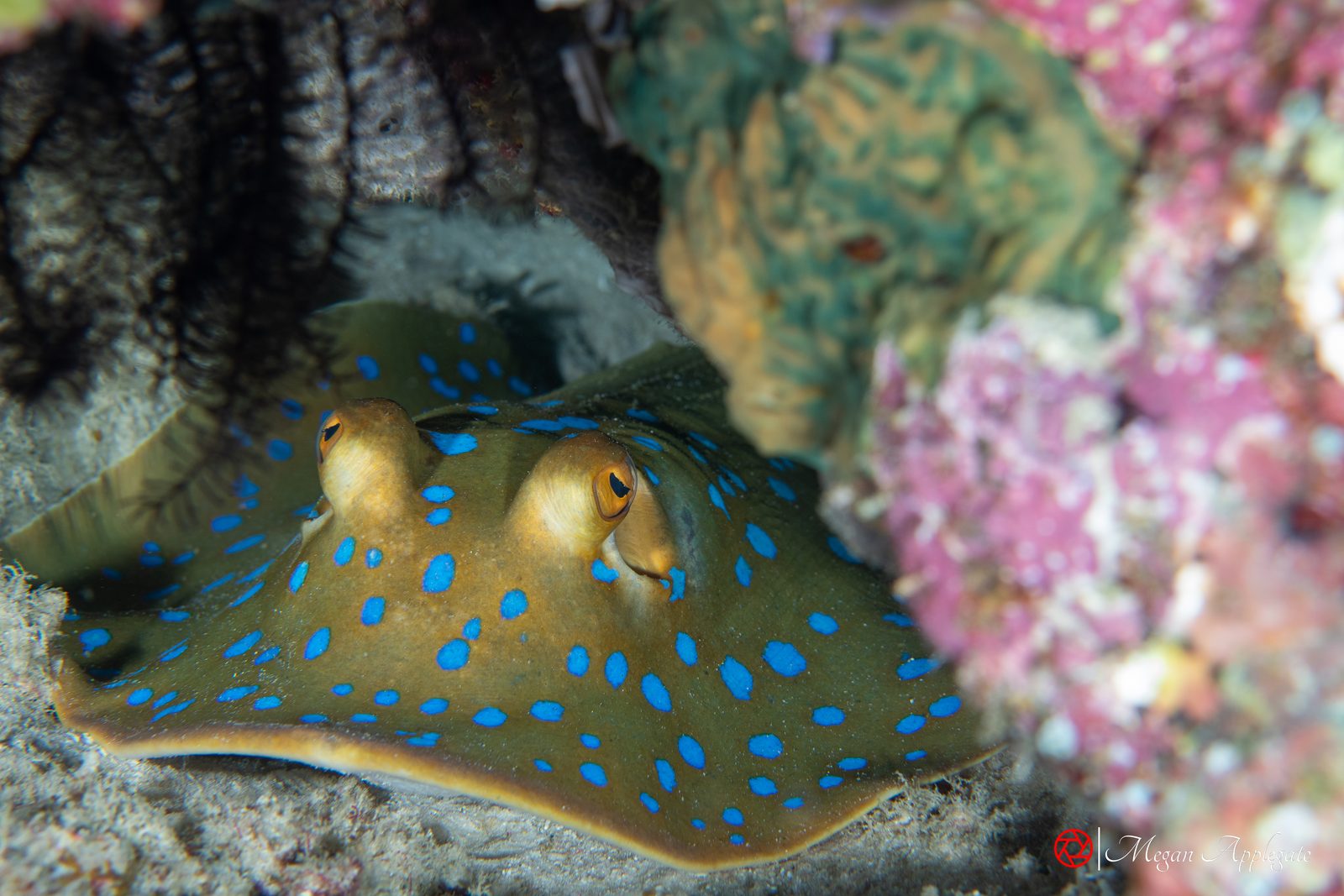
Oceania fantail ray (Taeniura lessoni)
Oceania fantail ray. Photo © Megan Applegate, Solomon Islands, September 2025.

Background photo: Megan Applegate (Solomon Islands)

Sharks

The reef sharks

3 species · key marks on each

Reef sharks are seen year-round, often more from June to September (Dive The World). The best-documented places are Marovo’s passes and the east side of Nggatokae, both listed as Important Shark and Ray Areas (ISRA Charapoana Passage; ISRA Gatokae).

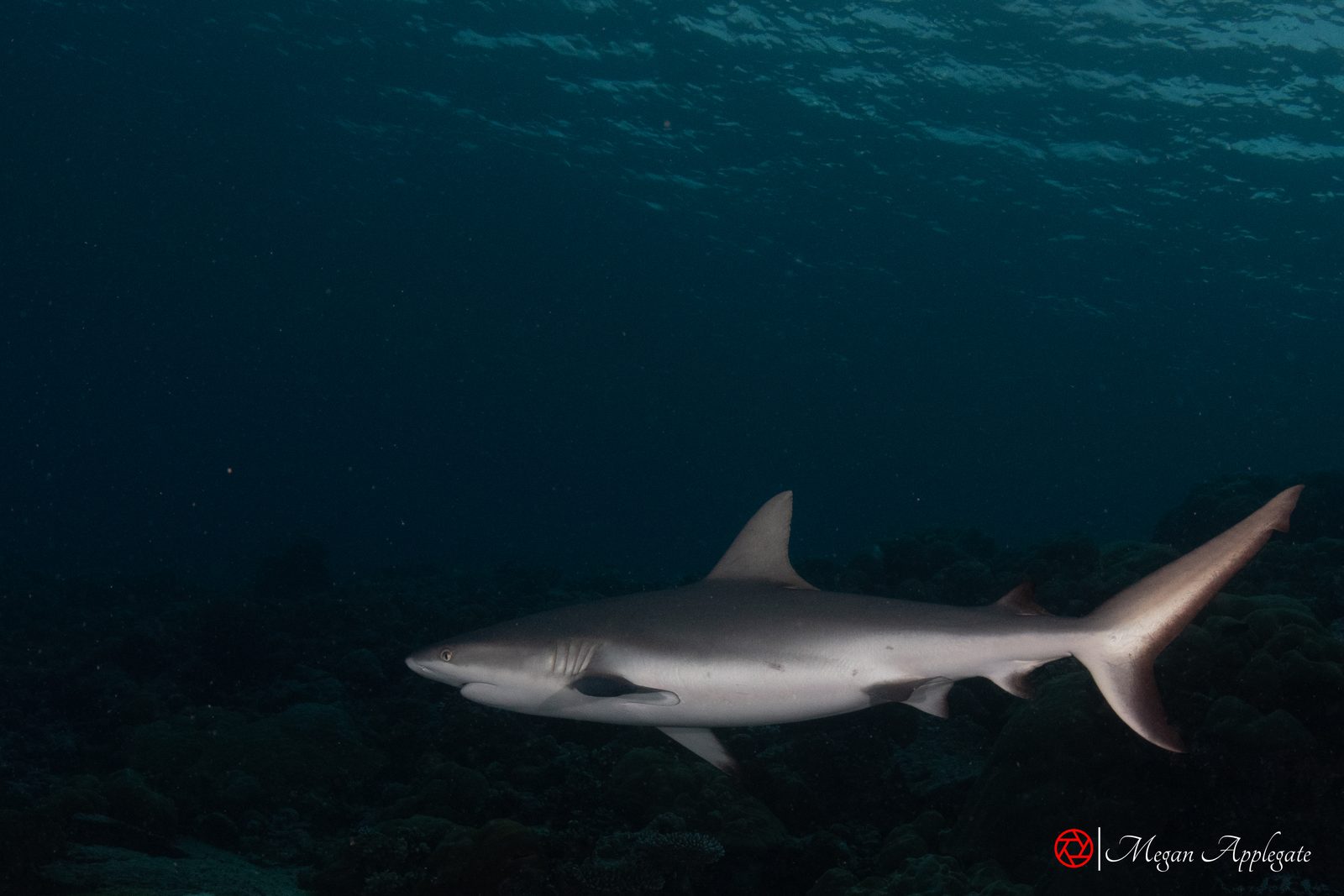
Grey reef shark (Carcharhinus amblyrhynchos)
Grey reef shark. Photo © Megan Applegate, Palau, January 2023.

Grey reef shark Carcharhinus amblyrhynchos

A stocky reef shark, most under 1.9 m long, with a broad, rounded snout. Listed as Endangered on the IUCN Red List (Wikipedia).

Key marks: A broad black band along the whole trailing edge of the tail. In the Pacific the first dorsal fin is plain grey, while the other fins have dusky to black tips (Wikipedia). A shark that hunches, raising its snout, dropping its pectoral fins and swimming stiffly from side to side, is making a threat display, usually at a diver who approached or followed it (Wikipedia): back away.

In the Solomons: The shark of Marovo’s passes. In Charapoana Passage groups of 2–6 swim through regularly, some with mating scars (ISRA Charapoana Passage). Off Kicha Island on the east side of Nggatokae, divers saw 2–5 on most dives at 10–40 m from 2009 to 2024, groups of about 15 have been filmed, and sharks feed on bait balls around December; the ones measured there were young of the year (ISRA Gatokae). Uepi Point has “an impressive number”, and a resident group gathers at the Uepi Island jetty in about 5 m (Divernet (Uepi)). Also reported at Twin Tunnels in the Florida Islands (Dive The World) and, as juveniles, at Karumolun Point in the Russells (DAN Alert Diver).
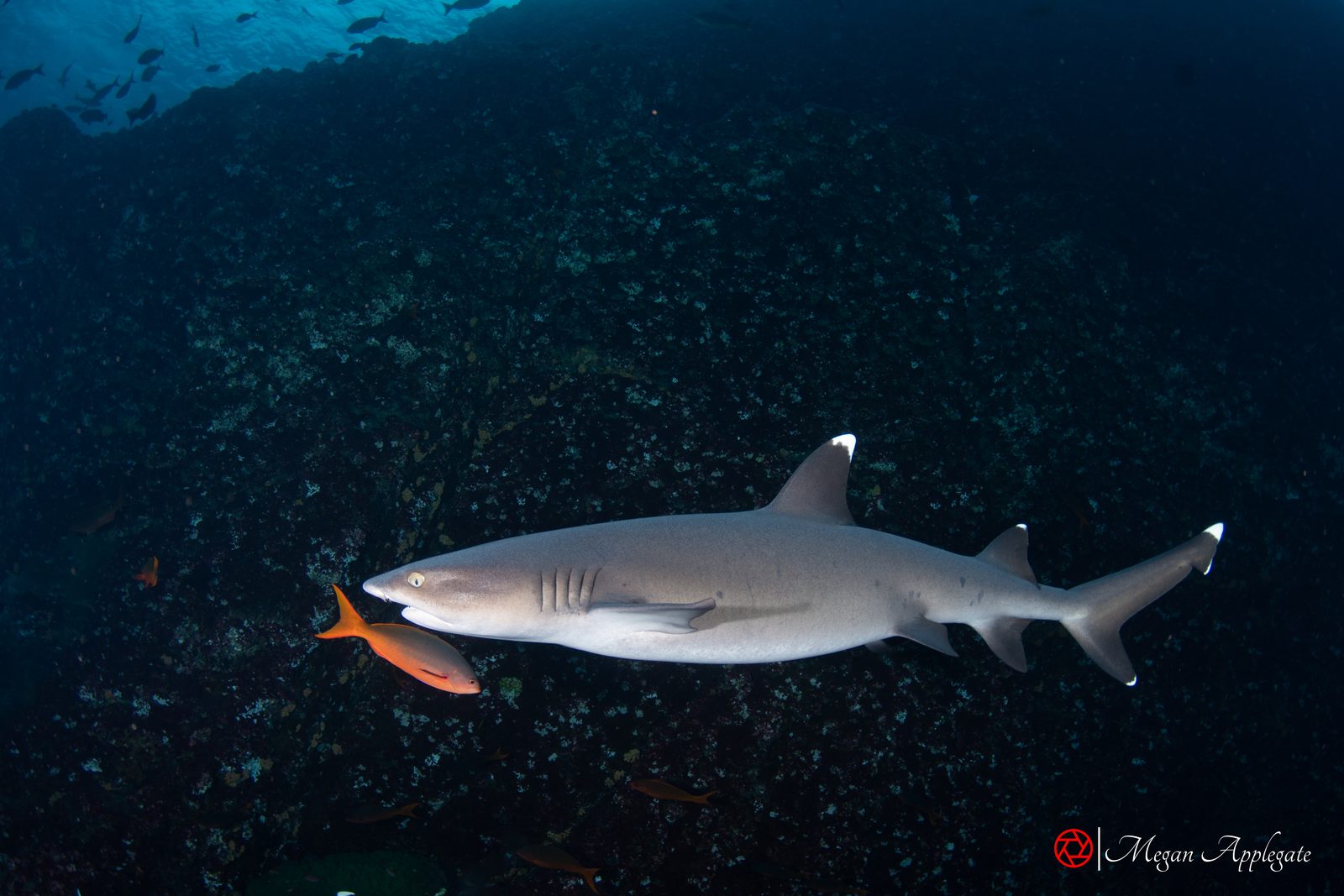
Whitetip reef shark (Triaenodon obesus)
Whitetip reef shark. Photo © Megan Applegate, Socorro, Mexico, December 2023.

Whitetip reef shark Triaenodon obesus

A slim, fairly small reef shark with white tips on the first dorsal fin and the upper tail lobe. It spends much of the day resting on the bottom, in caves and under ledges.

Key marks: Small and slim, with a short, blunt snout. A white tip on the first dorsal and on the upper lobe of the tail, often on the lower lobe too. The pectoral fins are plain. Usually lying still on sand or under a ledge during the day. Do not confuse it with the silvertip, which is much bigger, has white edging on all its fins, and does not rest.

In the Solomons: Off Kicha, Malemale and Mbulo on the east side of Nggatokae, divers saw 2–5 every month at 10–40 m from 2009 to 2024, often travelling in threes. Baited cameras there recorded up to five in one frame at Malemale, the highest count anywhere in the Solomon Islands; the sharks measured were juveniles (ISRA Gatokae).

Blacktip reef shark Carcharhinus melanopterus

A small shark of shallow reefs, usually 1.6 m or less, often in only a few metres of water near shore. Vulnerable on the IUCN Red List (Wikipedia).

Key marks: Crisp black tips on the fins, boldest on the first dorsal and the lower lobe of the tail and set off by a paler border; a white band runs along the side from above the anal fin (Wikipedia).

In the Solomons: Groups of 3–10 in Charapoana Passage, and newborn sharks of 50–70 cm in its shallow sandy water (ISRA Charapoana Passage).

Sharks in Marovo

Sharks are not eaten in Marovo, and people there regard reef sharks somewhat like dogs; one long-time photographer says you will see sharks on virtually every dive (Indo Pacific Images). Off Nggatokae, small-scale longlining targets grey reef sharks near the reef edge (ISRA Gatokae).

Rays

Mantas and stingrays

Reef mantas at Devil’s Highway and the Marovo cleaning stations

Reef manta Mobula alfredi

A manta of coasts and reefs, typically 3–3.5 m across and up to about 5.5 m, smaller than the giant oceanic manta. Vulnerable on the IUCN Red List (Wikipedia).

Key marks: Seen from above, the pale shoulder patches blend softly into the dark back and the gap between them forms a “Y”, not the sharp-edged “T” of the oceanic manta. Underneath, dark spots sit between the gill slits and along the trailing edges of the fins and belly (Wikipedia).

In the Solomons: Devil’s Highway in the Florida Islands has a colony, with 10 or more mantas of 3–5 m feeding (Dive The World), up to a dozen on a good day (PADI). In Marovo, 3–5 cruise and feed in Charapoana Passage and visit a cleaning station there (ISRA Charapoana Passage), and another cleaning station at Sambulo Island is in about 20 ft (6 m) (DAN Alert Diver). Mantas are most reliable from March to May and August to December (Dive The World).

Oceania fantail ray (Melanesian blue-spotted ribbontail ray) (Taeniura lessoni)
Oceania fantail ray (Melanesian blue-spotted ribbontail ray). Photo © Megan Applegate, Solomon Islands, September 2025.

Oceania fantail ray (Melanesian blue-spotted ribbontail ray) Taeniura lessoni

A small blue-spotted stingray of Melanesia, about 21–22 cm across, described only in 2016 and named after the French naturalist René Lesson. It is known from Papua New Guinea, the Solomon Islands, Vanuatu and Fiji, usually inshore on coral reefs (Wikipedia).

Key marks: Like the familiar blue-spotted ribbontail ray, but without the pair of blue stripes along the sides of the tail; the tail has no fold on top, only a firm ridge (Wikipedia).

In the Solomons: Photographed resting under a coral head. Data Deficient on the IUCN Red List (Wikipedia).

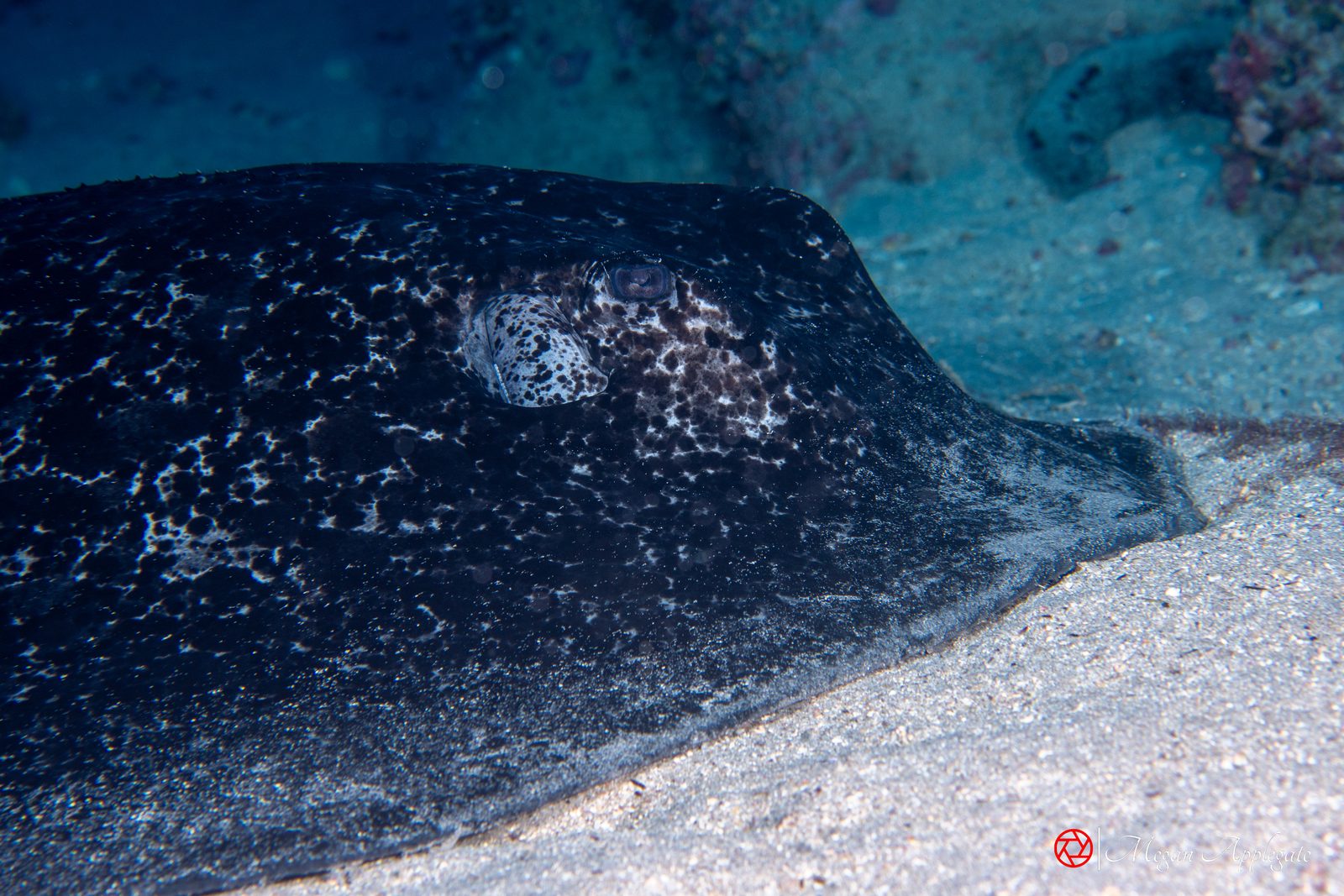
Blotched fantail ray (marbled ray) (Taeniurops meyeni)
Blotched fantail ray (marbled ray). Photo © Megan Applegate, Cocos Island, August 2024.

Blotched fantail ray (marbled ray) Taeniurops meyeni

Key marks: A broad, rounded, thick disc, grey with dense dark mottling, and a tail shorter than the disc with a deep fin fold underneath. Usually resting on sand or under ledges.

In the Solomons: “Marble rays” are reported at Lumalohi Passage off Guadalcanal (DAN Alert Diver).

Also reported

Seen less often

Possible but unconfirmed on most dives

Other sharks and rays

Spotted eagle rays at Karumolun Point in the Russells (DAN Alert Diver), where eagle rays are listed with jacks, barracuda and reef sharks (Dive The World). Mobula rays at Rainbow Reef in the Russells and at Kavachi Corner in Marovo (Dive The World). Nurse sharks are mentioned in a PADI report (PADI).

Saltwater crocodiles

Saltwater crocodiles live in the Solomons in low numbers (UNESCO Tentative List). They are reported in the ponds of the Russell Islands (DAN Alert Diver), and a diver at Mirror Pond saw a small one asleep (PADI). Ask your guide before swimming in ponds, mangroves or river mouths.

At a glance

Sharks and rays in the Solomons

Where and when, in one table

Table — Sharks and rays in the Solomon Islands, from the ISRA factsheets, Dive The World, DAN, PADI and Divernet. Individual dives vary.
SpeciesWhere reportedWhen
Grey reef sharkCharapoana Passage, Uepi, Kicha (Nggatokae), Twin Tunnels, Karumolun PointAll year; more Jun–Sep; bait balls around Dec
Whitetip reef sharkKicha, Malemale and Mbulo (Nggatokae)All year
Blacktip reef sharkCharapoana Passage (newborns in the shallows)All year
Reef mantaDevil’s Highway; Charapoana Passage; Sambulo IslandMar–May and Aug–Dec
Oceania fantail rayCoral reefsAll year
Blotched fantail rayLumalohi Passage (Guadalcanal)All year

Photos

The Oceania fantail ray was photographed in the Solomon Islands in September 2025. The grey reef shark (Palau), whitetip (Socorro) and marbled ray (Cocos Island) are Megan Applegate’s photos from other trips, labelled with the place.