The reef
The southern end of the Mesoamerican Reef
Walls on the edge of the Cayman Trench
Roatán lies on the southern edge of the Mesoamerican Barrier Reef System, the second-largest barrier reef in the world (Wikipedia). The island sits on the Bonacca Ridge, an undersea mountain range next to the Cayman Trench, so its walls drop hundreds to thousands of feet (Scuba Diving 2018). Some of the corals off the West End are said to be more than 2,000 years old (PADI 2019).
Cordelia Banks
A staghorn stronghold
South-west of Roatán
Cordelia Banks, four coral banks south-west of Roatán, hold staghorn coral thickets covering 63,440 m². The Healthy Reefs Initiative measured 72.23% live coral cover there, against an average of 19% for the Mesoamerican Reef. Honduras declared the banks a Site of Importance for Wildlife in 2012, after about seven years of work by government and conservation groups (Coral Reef Alliance 2021).
Corals to know
Corals to know
Branching, brain, star and fan
Staghorn coral Acropora cervicornis
Critically Endangered; grows about 10–20 cm a year (Reef Renewal Foundation Bonaire).
Key marks: Round, antler-like branches with a large single polyp at each tip, at 1–15 m (Scuba Diver Life).
At Roatán: Covers 63,440 m² at Cordelia Banks (see below) (Coral Reef Alliance 2021); elkhorn and staghorn also grow at Coral Corral (Scuba Diving 2018).
Wikipedia · iNaturalist · Photos (Commons)
Grooved brain coral Diploria labyrinthiformis
Key marks: A brain coral with a groove running along the top of every ridge. The symmetrical brain coral has smooth, narrow ridges; the boulder brain coral, the largest and most common, has fine grooves down the sides of its ridges (Scuba Diver Life).
At Roatán: The first corals raised in Roatán’s new coral lab: 3,000 young grooved brain corals from one wild spawning (see Restoration) (California Academy of Sciences 2025).
Wikipedia · iNaturalist · Photos (Commons)
Lobed star coral Orbicella annularis
Key marks: Thick columns with domed tops. Its relatives form mountain-like peaks and ridges (mountainous star coral) or irregular plates in deeper water; the great star coral has large, puffy polyps (Scuba Diver Life).
Wikipedia · iNaturalist · Photos (Commons)
Common sea fan Gorgonia ventalina
Key marks: A soft coral spread in a flat, lacy fan 60–180 cm across, at 1–30 m (Florent’s Reef Guide).
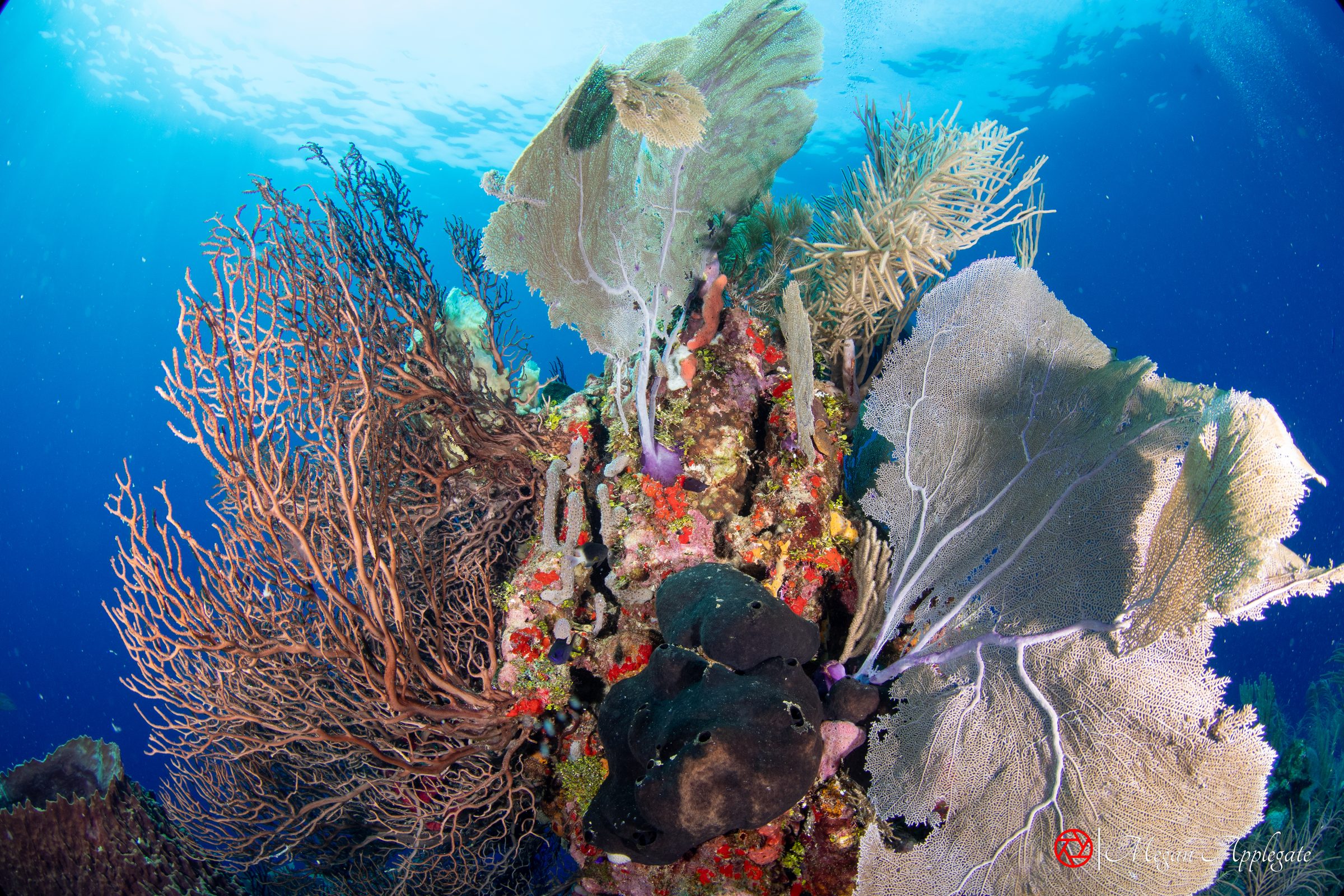
At Roatán: The sea fans in the background photos of this guide were photographed by Megan Applegate at Roatán.
Wikipedia · iNaturalist · Photos (Commons)
Fire coral stings
Fire coral (Millepora) is a hydrozoan, not a true coral: smooth, mustard to golden-brown with white tips, in branches, blades or boxes, and it also overgrows sea fans. It stings; if you are stung, rinse with seawater, not fresh water (Grand Bay Punta Cana).
Threats
Heat and disease
Bleaching in 2023 and SCTLD from 2020
Stony coral tissue loss disease (SCTLD) was first reported on Roatán in September 2020, at Flowers Bay. Within 13 months it had spread across the Bay Islands, affecting at least 28 coral species; Roatán and Utila were hit hardest, with the disease circling them at about 155 m a day (Truc et al. 2023).
The marine heatwave of 2023 and the bleaching that followed severely affected 40% of the Mesoamerican Reef’s corals (California Academy of Sciences 2025). Even so, the 2024 Healthy Reefs report card showed a slight rise in reef health across the region, the first improvement in five years (Coral Reef Alliance 2024).
Report sick coral
If you see coral with fresh white patches of dead skeleton spreading across it, tell your dive shop so the marine park can follow it up.
Restoration
Growing corals back
The Coral Restoration Center Roatán
The Sandy Bay–West End Marine Reserve was set up in 1989 (Scuba Diving 2018), and Roatán Marine Park started in January 2005 as a community-based non-profit (Wikipedia). On 18 June 2025 the park opened the Coral Restoration Center Roatán with the California Academy of Sciences, described as the first coral-rearing lab in Central America; its first use raised 3,000 young grooved brain corals from a single wild spawning (California Academy of Sciences 2025).